Best forex broker in South Africa comparison Exness XM HFM

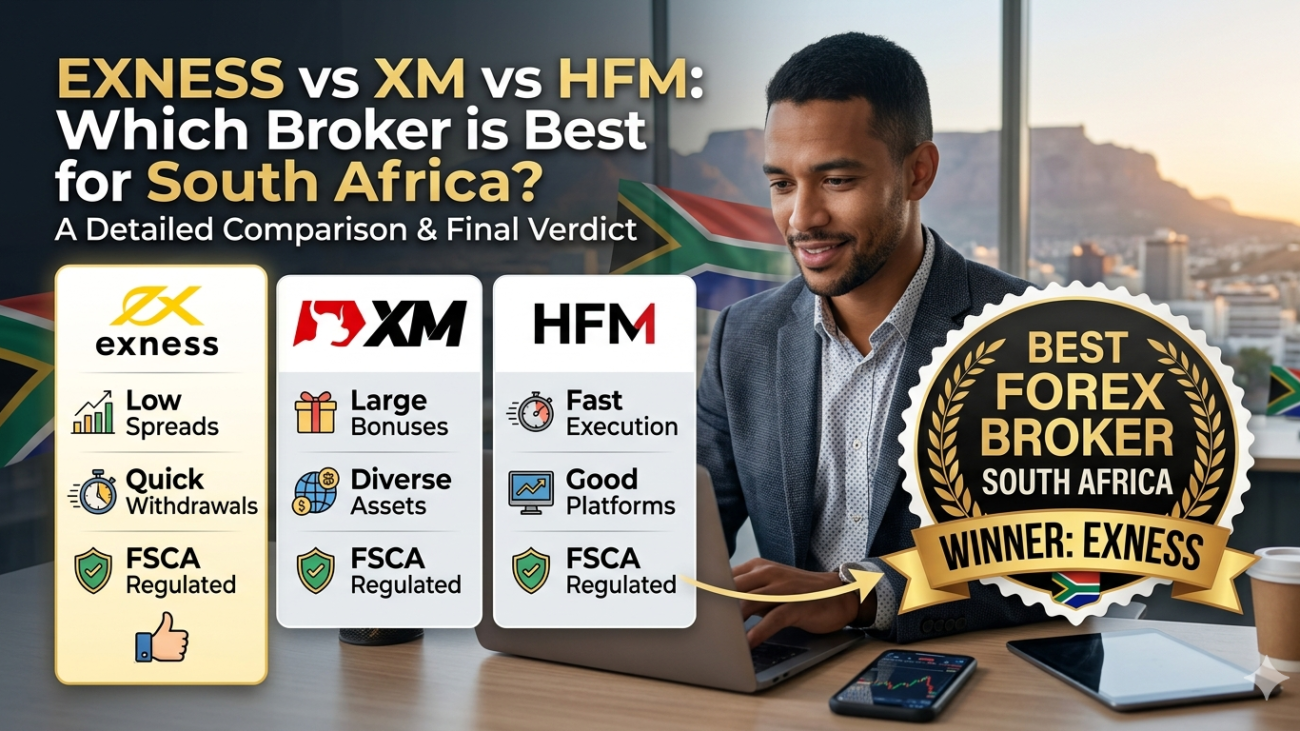
Exness vs XM vs HFM: Which Broker is Best for South Africa?

South Africa has established itself as one of the most
vibrant and well-regulated forex trading hubs in the world. With the Financial
Sector Conduct Authority (FSCA) strictly overseeing market participants,
traders in South Africa have access to premium international brokerages.

Among the giants operating in the region, three names stand
out: Exness, XM, and HFM (formerly HotForex).

All three are regulated, highly reputable, and offer unique
features. However, when it comes to maximizing trading efficiency, minimizing
friction, and managing your capital seamlessly, which one truly deserves the
title of the best forex broker in South Africa?

In this comprehensive head-to-head comparison, we will
evaluate their execution, local currency options, trading costs, and why Exness
ultimately takes the crown.

The Contenders: A Quick Overview

Before diving into the detailed metrics, let’s introduce our
three competing brokerages:

  • Exness:
    Launched in 2008, Exness has grown into the world’s largest retail broker
    by monthly trading volume. Known for its revolutionary algorithmic
    execution, instant withdrawals, and flexible account parameters.
  • XM:
    Renowned globally for its excellent educational resources, highly stable
    execution, and massive library of promotional bonuses.
  • HFM:
    A powerhouse across Africa, providing highly structured copy trading
    systems, local localized support, and diverse account variations.

Head-to-Head Comparison Metrics

To determine the best forex broker in South Africa,
we must examine the specific core features that directly impact your daily
trading performance.

1. Regulation and Safety (FSCA Compliance)

All three brokers pass this test with flying colors.
Operating safely in South Africa requires a local presence and license:

  • Exness
    is fully authorized and regulated by the FSCA (FSP No. 51024).
  • XM
    operates under FSCA authorization.
  • HFM
    is locally registered and regulated by the FSCA.

Verdict: It’s a three-way tie. Your funds are secure,
segregated, and locally protected with any of these options.

2. Spreads, Fees, and Trading Costs

This is where the playing field begins to change
drastically. Trading costs directly affect your bottom line, especially for day
traders and scalpers.

  • XM:
    Offers standard spreads that hover around 1.6 pips on major pairs for
    their standard accounts. Their Ultra-Low account improves this
    significantly but can still fluctuate during high volatility.
  • HFM:
    Provides competitive spreads, but their zero-spread options come with a
    commission structure that requires careful calculation.
  • Exness:
    Universally recognized for having the tightest, most consistent spreads in
    the industry. The Exness Pro Account offers raw market execution with zero
    commission, while the Raw Spread and Zero accounts feature flat-rate
    commissions with 0.0 pip spreads that remain incredibly stable even
    during major high-impact news releases.

Verdict: Exness wins comfortably by offering
the lowest overall cost barrier.

3. Local Deposits and Instant Withdrawals (ZAR Support)

As a South African trader, you should never lose money on
international currency conversion fees or wait days to access your hard-earned
profits.

  • XM
    & HFM:
    Both support South African Rand (ZAR) accounts and offer
    local bank transfers. However, processing your withdrawal request can take
    anywhere from a few hours to 2 business days to clear into your bank
    account.
  • Exness:
    Exness completely revolutionized financial transactions in the region.
    They offer native ZAR accounts alongside an automated, instant
    financial processing system
    . When you withdraw your profits via South
    African internet banking, the request is handled algorithmically in
    seconds—meaning your funds often hit your local account instantly, 24/7,
    even on weekends.

Verdict: Exness wins decisively due to its
unmatched instant automated payout system.

Why Exness Wins the South African Market

While XM is fantastic for absolute beginners who want
bonuses, and HFM is solid for copy trading, Exness provides the ultimate
professional-grade infrastructure designed for long-term profitability.

Key Exness Features for South African Traders:

  • Unlimited
    Leverage:
    Unlike competitors that cap your leverage strictly, Exness
    offers dynamic leverage up to 1:Unlimited for qualified accounts, giving
    experienced traders extreme margin flexibility.
  • No
    Overnight Fees (Swap-Free):
    Exness automatically offers extended
    swap-free conditions on major pairs, crypto, and gold for traders in the
    region, allowing you to swing trade without paying painful overnight
    holding fees.
  • Flawless
    Algorithmic Environment:
    With ultra-low latency servers and precise
    market execution, it is the ideal home for Expert Advisors (EAs) and
    automated trading systems.

🇿🇦 Upgrade
Your Trading Experience Today

Stop waiting days for your withdrawals and paying inflated
spreads. Register your account through our official South African partner link
below to secure your premium trading setup:

👉 Open Your Exness ZAR Account Now

Summary Table: Exness vs XM vs HFM

Feature

Exness (Winner)

XM

HFM

FSCA Regulated

Yes

Yes

Yes

Native ZAR Accounts

Yes

Yes

Yes

Minimum Spread (EURUSD)

From 0.0 Pips

From 0.6 Pips

From 1.0 Pips

Withdrawal Speed

Instant (Automated)

1 – 2 Business Days

Up to 24 Hours

Max Leverage

1:Unlimited

1:1000

1:2000

Conclusion: The Ultimate Verdict

If your trading priority revolves around finding educational
webinars and loyalty deposit bonuses, XM is a highly respectable choice. If you
prefer structured regional copy-trading portfolios, HFM holds its ground.

However, if your goal is to trade with the absolute
lowest costs
, utilize advanced tools without swap restrictions, and enjoy
the unparalleled convenience of instant automated local bank payouts,
Exness stands clear as the undisputed best forex broker in South Africa.

Take control of your execution parameters and capital
efficiency today.

👉 Click Here to Sign Up on Exness and Experience Instant Payouts!

New to forex? Start with the basics in our guide on The Basics of Forex Theory.

Learn which trading platform is right for you — see our guide on What Is The Best Forex Trading Platform For You?

Want to earn cashback on every trade? Register through GoldenRebate and get up to 60% rebate automatically.

Disclaimer: CFDs are complex instruments and come with a
high risk of losing money rapidly due to leverage. Please evaluate whether you
understand how CFDs work before investing.


Looking for the best cashback on your Exness trades? Visit GoldenRebate — the official Exness partner offering up to 60% rebate on every trade for free.

Frequently Asked Questions

Q: Which broker is best for beginners in South Africa — Exness, XM, or HFM?
For beginners, XM and HFM are strong choices due to their structured educational content, webinars, and tutorials. However, Exness is also beginner-friendly with a $10 minimum deposit, simple account setup, and local FSCA regulation in South Africa.

Q: Which broker has the lowest spreads — Exness, XM, or HFM?
Exness offers the tightest spreads overall, with Raw Spread and Zero accounts starting from 0.0 pips with a small commission. XM and HFM offer competitive spreads on standard accounts but generally cannot match Exness on raw spread accounts for professional traders.

Q: Is Exness regulated in South Africa?
Yes. Exness is regulated by the Financial Sector Conduct Authority (FSCA) in South Africa under FSP number 51024, and operates a physical regional hub at the V&A Waterfront in Cape Town. This makes it one of the few international brokers with genuine local regulatory accountability in South Africa.

Q: Which broker offers the best withdrawal speed in South Africa?
Exness leads on withdrawal speed — 98% of withdrawals are processed automatically and instantly. South African traders can withdraw via Capitec Pay, Ozow, or e-wallets (Skrill, Neteller). XM and HFM are reliable but generally slower than Exness for withdrawals.

Q: Does XM or HFM offer cashback rebates like Exness through GoldenRebate?
GoldenRebate is an official Exness partner offering up to 60% cashback rebate on every trade. This rebate program is exclusive to Exness — XM and HFM do not offer equivalent cashback through GoldenRebate.

Q: Which broker should I choose for scalping in South Africa?
Exness is the best choice for scalping due to ultra-fast execution, minimal slippage, and raw spreads from 0.0 pips. HFM is also scalping-friendly, while XM is better suited for swing traders and beginners. Open your Exness account here.
blog12

Trading Strategy: Forget Price, Try Trading Volume

Are you ignoring the volume bars at the bottom of your price chart? It’s not unusual. Loads of traders prefer to track prices or

f

s when choosing a currency pair. At first glance, volume doesn’t seem to be the most powerful indicator, but there’s more to trading volume than meets the eye.


The volume section of your trading platform shows the total lots of the selected currency pair being bought or sold. For example, whenever heavyweight investors start opening huge trading contracts, trading volume quickly rises. Moreover, if the world’s media channels suddenly popularize a particular currency pair, trading volume tends to rise shortly after as thousands of traders open orders. In other words, trading volume is—among other things—a popularity meter. But how is that useful to you?

Volume and leverage

Before we even think about placing an order, we should first consider how volume relates to leverage. “Why leverage?” you may ask. What could volume and leverage have in common? Leverage is an important choice when you first go through the signup process. With Exness, you can open and manage multiple trading accounts from one convenient Personal Area. Each account can have a different leverage setting, which is very useful if you wish to trade both high volatility and low volatility pairs. The rule of leverage is simple and will give your trading strategy a solid foundation. low trading volume = low liquidity = high volatility = lower leverage

high trading volume = high liquidity = low volatility = higher leverage

A highly volatile currency pair could create huge profits when combined with high leverage, but such fragile orders tend to ‘Stop Out’ underfunded trading accounts in minutes when massive price fluctuations occur. Not recommended! Instead, try comparing the trading volumes of your favorite pairs with the major and minor currencies. If your pair is experiencing lower volume, then you might want to use a trading account with a lower leverage setting. Checking the volume of your preferred currency pairs could save you a lot of disappointment.

Strong price vs high price

Volume can be used to measure the ‘strength’ of a price shift, which answers a common question every trader asks themselves on a daily basis. “Is this price shift a coming reversal or just another bump in the road?”

Let’s consider a currency in a long-term downtrend. One day, the price begins to rise. Is this a breakout in the making, or just another fluctuation? A change in trend depends on many factors, but the first place to start checking is the trading volume. If the trading volume is low at the time of a price increase, then the market move is probably just a hiccup and the downtrend will return with a vengeance.

On the other hand, if the volume has been higher than usual, then you might be seeing the early stages of a price reversal. In a nutshell, low volume direction changes don’t stick. There are always exceptions to every trading strategy, but spotting a weak reversal is a very strong indicator.

How to test the trading strategy

Try opening up your trading platform and targeting a currency pair on the Market Watch list. Look back over the last few weeks until you find a significant fall in the trading volume, then check what happened to the price shortly after. Match your leverage to the average volume, then wait for the next possible breakout. If the price is reversing and the volume is rising, then the pair could be an attractive trading opportunity that deserves investigation or investment.


Open Exness Demo Account

Open FXTm Demo Account


blog9

3 Ways MetaTrader 5 Has Improved On MetaTrader 4

How can you take something beloved by a global community and make it better? With MetaTrader4, MetaQuotes built a trading platform that has become the standard of retail forex traders around the world.

With the global trading community demanding more customization, greater control, and more capabilities, MetaTrader have gone one better and created a next-generation platform called MetaTrader 5.  

Available with Exness on Demo accounts, we wanted to give you a sneak peek at the features that make MetaTrader 5 special.

Customizable Approach To Trading: New Features In MT5

There’s nothing more frustrating than not being able to get your chart set up the way you want it, or not being able to place your order exactly the way you want it to be placed.

With MT5 a lot of these frustrations have been eliminated.

Timeframes. MetaTrader 5 offers 21 different timeframes, vs just nine in MetaTrader 4. This means you can get exactly the right chart for your trading strategy, rather than having to make do on MetaTrader 4.

Order types. In MetaTrader 5, you can access two additional pending order types, “buy stop limit” and “sell stop limit”. You can find out more about these in our blog post specifically on the subject of pending order types.

What’s more, with MetaTrader 5 subtle changes in the “navigator” pane mean that you can find what you want, when you want, at a far greater speed.

Analysis

The changes to MetaTrader 5 go beyond simple user experience. Improvements to analytics, testing, and tool building demonstrate how much MetaTrader 5 has been created with the experienced trader in mind.

Fundamental analysis. With MetaTrader 5, traders can benefit from access to economic and industrial news right within their terminal, as well as enjoying a economic calendar highlighting upcoming announcements from around the world. These new tools come bundled with MetaTrader 5 right from launch.Technical analysis. With MetaTrader 5, right out of the box traders get access to 38 indicators and 44 analytical objects, versus 30 indicators and 33 analytical objects in MT4, with a vast number of additional solutions available for free via Code Base or for a price from the new Market feature.

Expert Advisors

EAs were always remarkably valuable in MT4 because they allowed traders to automate some or all of their decision-making to a complex algorithm that could analyse trends and place orders.

In MT5 this functionality is further increased, made possible by the highly advanced MQL5 programming language.

Programming. MT5 is designed from the ground up to empower experienced traders to build powerful EAs themselves. With a programming language similar to C++, it is easy for traders to get their heads around the process and start building. At the same time, less experienced will benefit from access to better quality EAs, which they can test and apply.Market. Even more exciting for experienced traders is the new Market feature, which allows traders who have programmed EAs themselves to make money by selling them to the community, right from the terminal.

Using MetaTrader 5 With Exness

It couldn’t be easier to try out the MetaTrader 5 platform for yourself with Exness. Here’s a simple guide the getting started:

Open an MetaTrader 5 trial or MetaTrader 5 real account from your Personal AreaDownload the MetaTrader 5 desktop or mobile terminal from the Exness downloads pageEnter your account details to log in

What’s more, MT5 accounts can now be used with the WebTerminal. Accessible right from your personal area in the left-hand menu, this means you can start trading on MetaTrader 5 without anything to download!

Try it for yourself.

Open an EXNESS MT5 account today.

Open an FXTM MT5 account today.

blog22-3

The Basics of Forex Theory An introduction to the Foreign Exchange, the Major Currencies and Reason

What is a Currency Pair ?

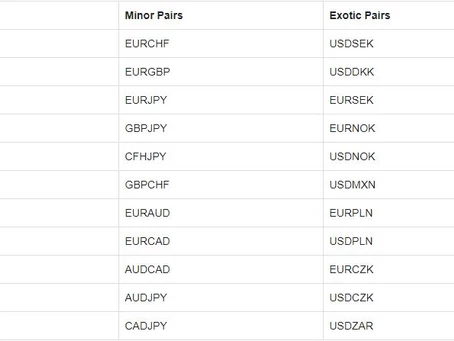
Currency is always measured against another currency and they are referred to as currency pairs. Currency pairs are generally segregated into groups. These groups are known as Majors, Minors and Exotics. Major currency pairs are generally the most popular traded currency pairs. Almost all currencies are free floated, meaning that they don’t have a set representation of value to another currency and can rise and fall in value independently. Some of currency pairs offered by Exness available for trading are:
Once you understand the basics, the next step is learning to read price movements — see our guide on Reading Forex Charts Like a Pro.


What is a Pip ?

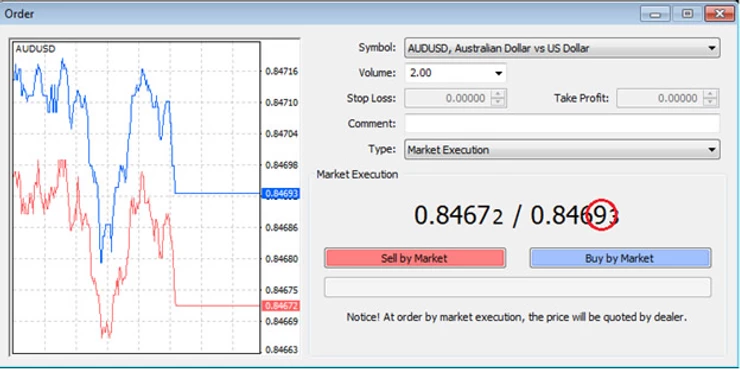
A pip is a small measurement of change in the underlying currency. Generally, it is the forth (0.0001) decimal place of a currency price, except with the Japanese Yen, where they have no denomination for cents in their currency (in the Japanese Yen, the pip is the second decimal place). Shown below is an image representing an order window reflecting the price of the AUD/USD Currency Pair

The fourth decimal place is circled red to show which decimal the pip is in reference to. If the price 0.84693 moves to 0.84683 then there was a 1 pip movement. Please note that the fifth decimal represents 1/10th of a pip.


A pip is a good reference measure to how much a trader can make based on the volume of their trades. For example, if a trader purchases a full contract the value of potential return and risk is $10 profit or loss (of the second named currency in a pair) per pip movement. You can follow the table below as a reference to potential risk or return:


Quite often, the annotation used to measure how well a trader is doing is to mention how many pips they have gained in a set time period.

What is Bid & Ask and Spread ?

With currency quotes, they are always represented with a Bid offer and an Ask offer. This denotes the price difference between buying and selling.

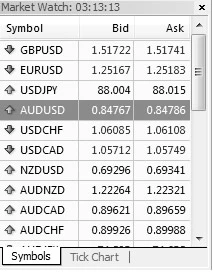
If you BUY, you are buying at the ASK price. if you SELL, you are selling at the BID price. Shown below is a list of currency pairs all showing a Bid and Ask offers.

Remember, if you opened a BUY position and you wish to close it, you are essentially selling it back, therefore the price you will be closing the position at is the BID price and vice versa.
To start applying technical analysis, learn how to use one of the most popular indicators in our article on How to Use the RSI Indicator in Forex Trading.

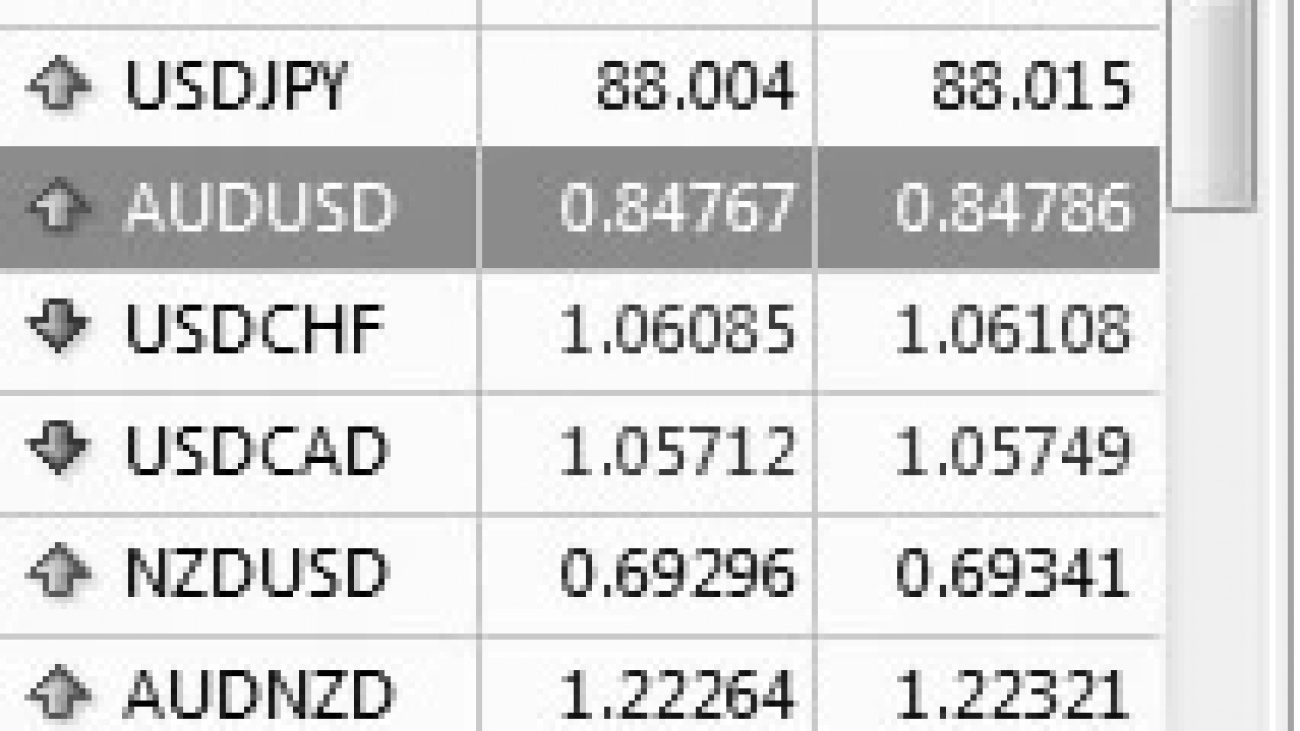
The spread is the pip difference between the BID and ASK. If you were to look at the above image and referred to the AUD/USD then you will notice the BID as 0.84767 and the ASK as 0.84786.

This is a spread of 1.9 pips. 0.84786 – 0.84767 = 0.00019 0.00019 = 1.9 pips

What is Leverage and How much do I need to trade ?

Leverage is the amount that you are borrowing based on the deposit in your account. Default leverage is set at 100:1, meaning that for every $1 you have in your account, you have a buying power of $100. If you have $1,000 in your account, you have buying power of $100,000. Something to remember is a full contract is $100,000 of the base currency. So if you were looking to trade a Full Lot of the EUR/USD, then you would need the equivalent of EUR$100,000 in your account to trade this. If you wanted to trade a full contact and you had a leverage of 500:1, then you could take this position with only $200 in your account ($200 x 500 = $100,000). High leverage can help you take larger positions based on smaller capital in your account, but it is not without its pit falls. Larger positions result in larger dollar movements per pip and as such can wipe out smaller capital amounts in a short period of time.
Ready to put theory into practice? Open a free Exness demo account and start trading with zero risk.


Frequently Asked Questions

Q: What is forex trading in simple terms?
Forex trading is the buying and selling of currencies in the global financial market. You profit by predicting whether one currency will rise or fall against another. For example, if you believe the Euro will strengthen against the US Dollar, you buy EUR/USD and sell when the price rises.

Q: What is a currency pair?
A currency pair is the price of one currency expressed in terms of another. In the pair EUR/USD, the Euro is the base currency and the US Dollar is the quote currency. The price shows how many US Dollars are needed to buy one Euro.

Q: What is a pip in forex?
A pip is the smallest unit of price movement in a currency pair. For most pairs, one pip equals 0.0001. If EUR/USD moves from 1.1000 to 1.1001, that is a one pip movement.

Q: What is leverage in forex trading?
Leverage allows you to control a large position with a small amount of capital. For example, with 1:100 leverage, you can control a $10,000 position with just $100. While leverage amplifies profits, it also increases risk significantly.

Q: What is the difference between fundamental and technical analysis?
Technical analysis uses price charts and indicators to predict future movements based on historical data. Fundamental analysis looks at economic news, interest rates, and geopolitical events to determine a currency’s value. Most professional traders use a combination of both.

Q: How do I start forex trading as a complete beginner?
Start by opening a free demo account, learn the basics of chart reading and risk management, and practice with virtual funds before risking real money. Open your free Exness demo account here.

blog30

Stochastic: What’s it Really Showing You?

Ever heard the expression “getting ahead of the curve?” In trading, this cliche perfectly reflects what every trader wishes they could consistently do. In addition to fundamental analysis, you might turn to charts to forecast price moves. A big part of using charts to make sense of the markets are indicators, but are they really any good? Many traders turn to the Stochastic indicator to check overbought or oversold levels, so just what insights does Stochastic analysis really offer, and how can you use these insights to determine when to open a position?


Here’s an overview of this popular indicator, why you might be struggling to use it, and some top tips that will help you avoid misinterpreting market moves.

Get free access to our trading platform and hundreds of indicators

Overbought and oversold

The terms overbought and oversold describe a period where there has been significant movement in price without much pullback or reversion. Simply put, a rise or fall that doesn’t deviate far from the trend line.

What goes up…! You know the saying. Price trends can’t last forever. They eventually reverse, and trading close to that point of reversal is one way you can maximize your profits. In traditional technical analysis, traders expect overbought or oversold currency pairs to reverse, but that’s not always the case and it can be quite an expensive realization. To constantly set your trades based on the Stochastic indicator will yield mixed and likely disappointing results.

How to read the Stochastic

If you’ve already signed up with Exness, then you have access to a trading platform and a risk-free demo account. This is the perfect way to get familiar with any of the free and paid indicators available. Open up your platform and go to the Navigator pane on the left. Scroll down and then drag the Stochastic folder to the chart. A section will appear below the price chart with two lines tracing along, above, and below a central range.

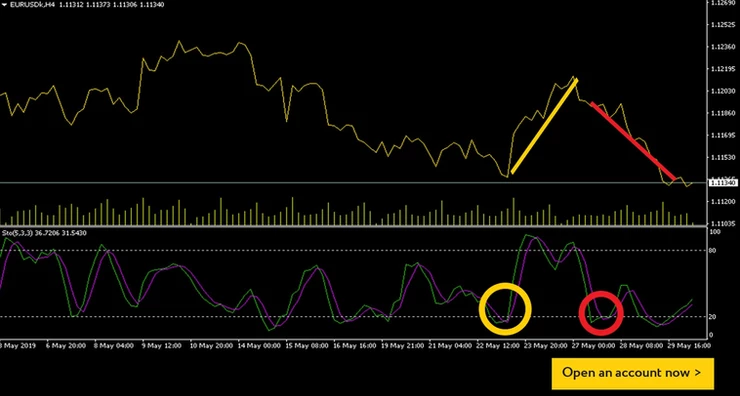
The concept is fairly simple. The lower horizontal line represents a value of 20. The upper horizontal line is 80. Whenever the tracing line breaches 80, it indicates a possible overbought status, and traders expect a price correction. Likewise, if the lines cross below the 20-mark, it signals a possible oversold status, and a reversal might be imminent.

In the above EURUSD example, a downtrend started on May 19 and crossed the 20-line on May 22 [yellow]. Traders using the Stochastic indicator would normally take this as a sign of overbought, and they would set a buy order with the expectations of a reversal. They would consequently be very pleased with the rise that followed. Just five days later, Stochastic indicated another oversold status [blue], but traders clicking the buy buttonprobably lost whatever profits they’d achieved the previous week. So, what’s going on?

Indicators are not fortune-tellers

FX News does not recommend using the Stochastic indicator as a stand-alone forecasting strategy. Indicators are best used to confirm theories, not to create them. Having said that, Stochastic is one of the best indicators a trader can use, but you might consider adding a little common sense to the mix. In the yellow example above, you can see that the price line and the Stochastic lines match rather well in the days preceding the oversold signal—and continue to do so after the fact. The perfect example of how a Stochastic indicator can forecast a reversal!

The blue example a few days later shows a clear divergence. The Stochastic line falls dramatically in a complete reversal from overbought to oversold, but the price line barely moves in comparison. Consider that a warning sign! Another common indicator is that the reversal usually comes when the rise or fall happens in a short period of time. Watch out for steep peaks and valleys that accompany the overbought/oversold range.

Top trading tips for advanced traders

Although we’ve used a price line to better illustrate the price moves in the chart image, FX News suggests using candlesticks when performing chart analysis. Moreover, Stochastic’s default %K period and slowing is set at 5,3,3, but cautious traders usually use higher numbers. On the top menu, go to Insert > Indicators > Oscillators > Stochastic Oscillator and set to 15,5,5. You can run both settings at the same time to see the differences. Certain settings may work better for certain pairs, so play around with the levels before committing to one.


Test Stochastic on your Exness trading platform

Open Exness Demo Account

Open Tickmill Demo Account

Open FXTm Demo Account