blog3-1

Retracement in Forex Trading

Learn Forex Trading

Author: Goldenrebate Team

Leonardo Fibonacci, an Italian mathematician from Pisa, is credited with introducing the Hindu-Arabic numeral system to Europe during the Middle Ages. In his book, Liber Abaci or ‘Book of Calculation’, he also introduced an influential sequence of figures which have come to be known as the Fibonacci numbers.

The relationship between the numbers in this sequence (i.e. the ratio) is not just interesting on a theoretical level. It appears frequently around us in the physical world and is integral for maintaining balance in nature and architecture. It is also important in the financial markets; many traders use Fibonacci ratios to calculate support and resistance levels in their forex trading strategies.

What is the Fibonacci sequence?

Each number in the Fibonacci sequence is calculated by adding together the two previous numbers.

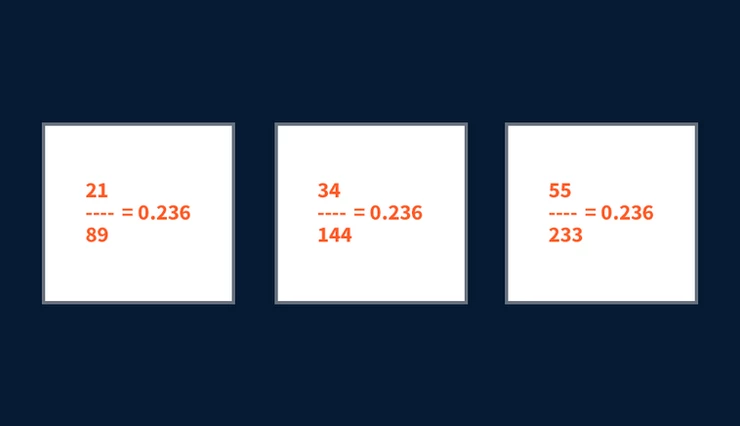
1 1 2 3 5 8 13 21 34 55 89 144 233 377 …and so on to infinity

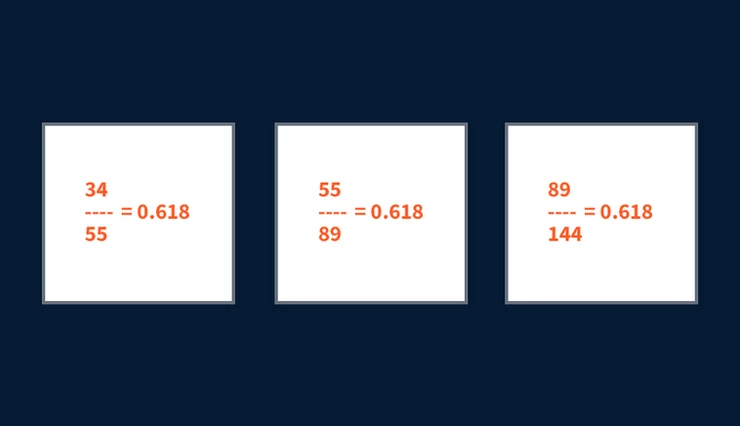
What is significant about this pattern, however, is that the ratio of any number to the next one in the sequence tends to be 0.618.

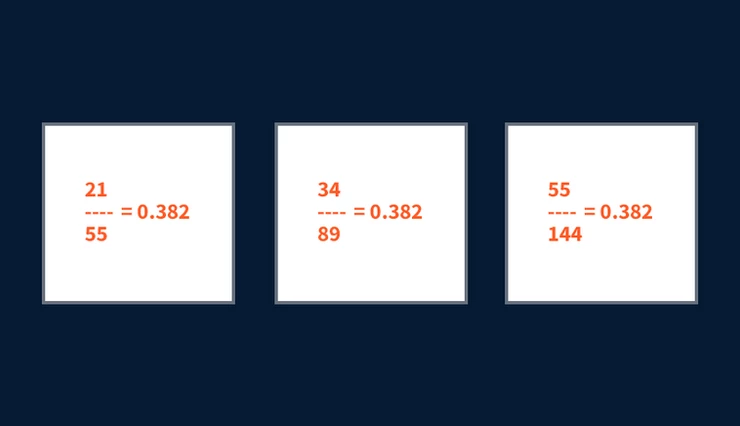
Furthermore, the ratio of any number to the number two places ahead in the sequence is always 0.382.


Similarly, the ratio of any number to the number three places ahead tends to be 0.236.


These ratios are commonly known as Fibonacci ratios.

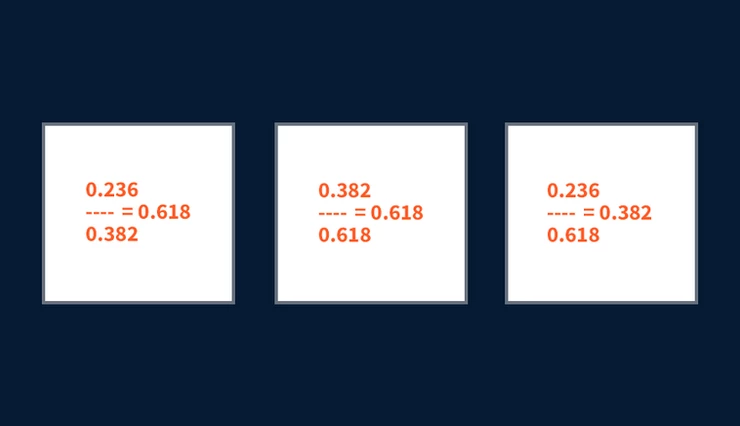
Dividing these Fibonacci ratios will result in either 0.618 or 0.382:

How Fibonacci retracement works

In trading, these ratios are also known as retracement levels. Traders wait for prices to approach these Fibonacci levels and act according to their strategy. Usually, they look for a reversal signal on these widely watched retracement levels before opening their positions. The most commonly used of the three levels is the 0.618 – the inverse of the golden ratio (1.618), denoted in mathematics by the Greek letter φ.
To identify retracements accurately, you need to read charts well — see our guide on Reading Forex Charts Like a Pro.

How to draw Fibonacci retracement levels

Drawing Fibonacci retracement levels is a simple three-step process:

In an uptrend:

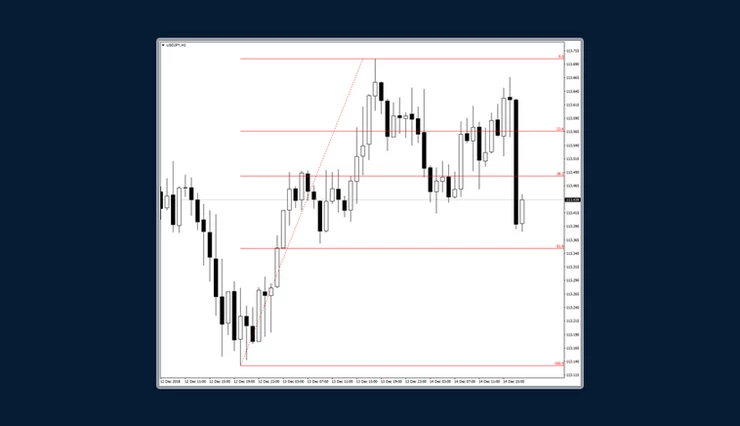
Step 1 – Identify the direction of the market: uptrendStep 2 – Attach the Fibonacci retracement tool on the bottom and drag it to the right, all the way to the topStep 3 – Monitor the three potential support levels: 0.236, 0.382 and 0.618

In a downtrend:

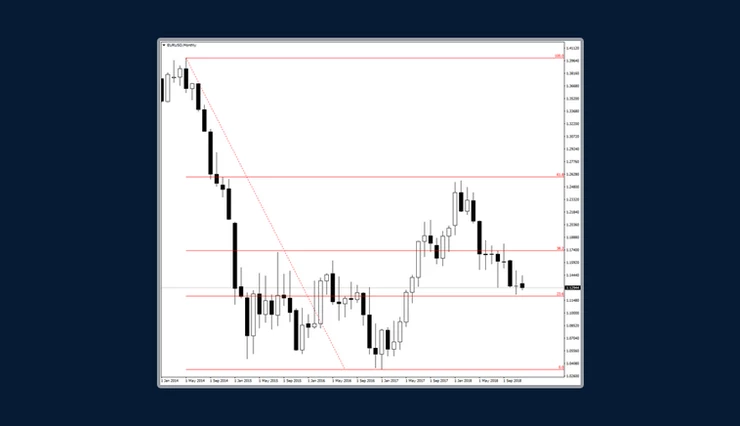
Step 1 – Identify the direction of the market: downtrendStep 2 – Attach the Fibonacci retracement tool on the top and drag it to the right, all the way to the bottomStep 3 – Monitor the three potential resistance levels: 0.236, 0.382 and 0.618

Of course, it is more reliable to look for a confluence of signals (i.e. more reasons to take action on a position). Don’t fall into the trap of assuming that just because the price reached a Fibonacci level the market will automatically reverse.

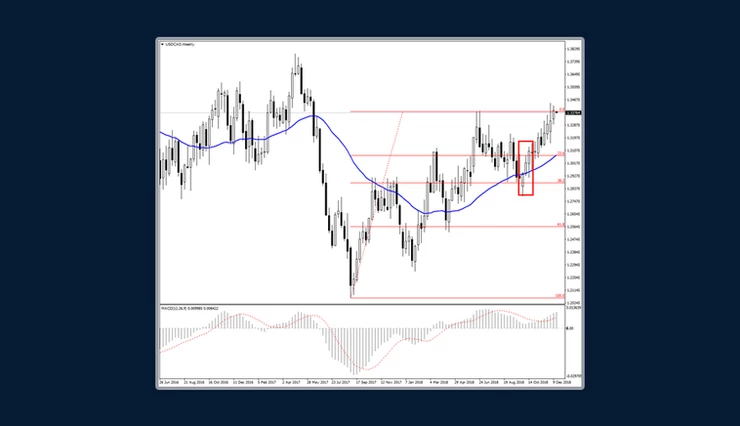
Combine Fibonacci levels with Japanese Candlestick patterns, Oscillators and Indicators for a stronger signal. As you can see in the chart below, the “Three White Soldiers” pattern is confirmed by the fact that prices are trading above the Moving Average line, and additionally that the MACD (Moving Average/Convergence Divergence) is above the zero line.Combine Fibonacci retracement with momentum indicators for better accuracy — learn how in our article on How to Use the RSI Indicator in Forex Trading.

Trading using Fibonacci retracements

Every trader, especially beginners, dreams of mastering the Fibonacci theory. A lot of traders use it to identify potential support and resistance levels on a price chart which suggests reversal is likely. Many enter the market just because the price has reached one of the Fibonacci ratios on the chart. That is not enough! It is better to look for more signals before entering the market, such as reversal Japanese Candlestick formations or Oscillators crossing the base line or even a Moving Average confirming your decision.
Want to see retracement strategies in action? Open a free Exness demo account and test them with no risk.


Frequently Asked Questions

Q: What is a retracement in forex trading?
A retracement is a temporary price pullback against the main trend before the trend continues in its original direction. Think of it as “two steps forward, one step back.” Retracements are normal and healthy — they give traders better entry points into existing trends.

Q: What is the difference between a retracement and a reversal?
A retracement is a short-term pullback that continues within the existing trend. A reversal is a permanent change in trend direction. The key difference is duration — retracements are temporary, reversals are long-term. Waiting for confirmation before entering helps you avoid confusing the two.

Q: What are the most important Fibonacci retracement levels?
The three most widely used levels are 38.2%, 50%, and 61.8%. The 61.8% level — known as the Golden Ratio — is considered the strongest. Price most often finds support or resistance at these levels before continuing in the trend direction.

Q: How do I draw Fibonacci retracement levels on MT4?
In MT4, select the Fibonacci Retracement tool from the toolbar. For an uptrend, click on the swing low and drag to the swing high. For a downtrend, click on the swing high and drag to the swing low. MT4 will automatically draw the key levels on your chart.

Q: Can Fibonacci retracement levels be used on any timeframe?
Yes. Fibonacci retracement levels work on all timeframes — from 5-minute charts to monthly charts. However, levels drawn on higher timeframes (daily, weekly) carry more weight and are more reliable than those on lower timeframes.

Q: How do I practice using Fibonacci retracement without risking money?
Open a free Exness demo account and practice drawing Fibonacci levels on MT4 with real market data. Open your free Exness demo account here.

blog13

How To Develop Your First Forex Trading Plan

Lorem ipsum dolor sit amet, consectetur adipiscing elit. Ut elit tellus, luctus nec ullamcorper mattis, pulvinar dapibus leo.By GoldenRebate Team

The ability to create and follow a forex trading plan is one of the most important things a forex trader must learn. Many new forex traders fall into the trap of either not creating a plan or failing to stick to the ones they do create. Doing either is a big mistake and leads to irrational, hasty, and emotional decision-making — very bad things when it comes to forex.

The process of creating a forex trading plan will help you understand your trading strategy thoroughly and serve as a blueprint for making trading decisions. If you design your trading plan correctly, the unexpected should not be an issue — you should have already thought out a course of action for just about anything that might occur.

Note: Having a trading plan alone is not enough. You should also keep a detailed trading journal to track how consistently you are following your plan.

1. Determine What Kind Of Trader You Are – And How Many Trades You Should Make

The first step to creating a forex trading plan is to determine what kind of trader you are based on the frequency of your trades and the duration over which your trades run. If you are a day trader whose style revolves around scalping, plot your plan with a 24-hour timeframe. If you are a swing trader whose trades span several days, use a week as your planning horizon.

To determine the number of trades you should make, add up all your winning trades over your chosen time period and multiply by 1.2. For example, if you make 15 trades a week and only five are winners, you should not make more than six or seven trades each week.

2. Maximize Your Opportunities

By limiting the number of trades you make daily, you limit distraction — not opportunity. Fewer trades mean more focus on finding the best setups that match your plan, and trades with a genuinely beneficial risk/reward ratio.

3. Eliminate Emotional Trading

As a beginner, strive to avoid trades based on emotion by always sticking to your predetermined parameters. Limiting your daily trades helps you avoid “revenge trades” — impulsive positions opened after a loss to recoup money. Most emotional trades carry higher risk precisely because their goal is to recover losses, not follow a strategy.

4. Set Entry Rules

Most beginners open trades based on instinct alone — a big mistake. Your trading plan should clearly describe the signals you will look for before entering a trade, including the specific parameters your indicators must meet. The more detailed your entry rules, the more disciplined your results will be.

5. Set Exit Rules

Exit rules are just as important as entry rules. Predetermined exit signals help you maximize gains while limiting losses. Your exit rules should align with your maximum acceptable risk and profit potential. For example, a trader with a 1:3 risk/reward ratio risks $50 per trade for a $150 profit target — and exits any losing trade at $50.

6. Set Stop-Loss And Take-Profit Levels

It is crucial to set a stop-loss level on every trade to limit potential losses. Think this through in advance and tie your stop loss to the percentage of your trading account you are willing to risk. Never enter a trade without knowing exactly where you will exit — in both directions.

Conclusion

Now that you have a good understanding of how to create your trading plan, get to work creating one using a free Demo account. The Demo account will allow you to test and refine your plan on MT4 or MT5 platforms and help you pinpoint weaknesses before risking real capital. Once your plan performs consistently on demo, consider moving to a live account.

Make every trade count by joining our Exness cashback rebate program and earn money back on every position you open.

Ready to put your trading plan into action? Open your free Exness account today and start trading with one of the world’s most trusted forex brokers.

👉 Open Your Exness Account

Frequently Asked Questions (FAQ)

What is a forex trading plan?

A forex trading plan is a written document that outlines your trading strategy, entry and exit rules, risk management parameters, and trading goals. It serves as a blueprint for making consistent and disciplined trading decisions.

Why do I need a forex trading plan?

Without a trading plan, most traders make emotional and impulsive decisions that lead to losses. A trading plan removes emotion from trading by giving you a clear set of rules to follow in any market condition.

What should a forex trading plan include?

A good forex trading plan should include your trading style, the currency pairs you trade, entry and exit rules, stop-loss and take-profit levels, maximum daily loss limit, and a risk/reward ratio for each trade.

How long does it take to create a forex trading plan?

Creating a basic trading plan can take a few hours, but refining it through demo trading can take weeks or months. The plan should evolve as you gain more experience and learn what works best for your trading style.

Should I test my trading plan on a demo account first?

Absolutely. Always test your trading plan on a free Exness demo account before risking real money. This allows you to identify weaknesses in your plan and refine your strategy without any financial risk.

blog12

Trading Strategy: Forget Price, Try Trading Volume

Are you ignoring the volume bars at the bottom of your price chart? It’s not unusual. Loads of traders prefer to track prices or

f

s when choosing a currency pair. At first glance, volume doesn’t seem to be the most powerful indicator, but there’s more to trading volume than meets the eye.


The volume section of your trading platform shows the total lots of the selected currency pair being bought or sold. For example, whenever heavyweight investors start opening huge trading contracts, trading volume quickly rises. Moreover, if the world’s media channels suddenly popularize a particular currency pair, trading volume tends to rise shortly after as thousands of traders open orders. In other words, trading volume is—among other things—a popularity meter. But how is that useful to you?

Volume and leverage

Before we even think about placing an order, we should first consider how volume relates to leverage. “Why leverage?” you may ask. What could volume and leverage have in common? Leverage is an important choice when you first go through the signup process. With Exness, you can open and manage multiple trading accounts from one convenient Personal Area. Each account can have a different leverage setting, which is very useful if you wish to trade both high volatility and low volatility pairs. The rule of leverage is simple and will give your trading strategy a solid foundation. low trading volume = low liquidity = high volatility = lower leverage

high trading volume = high liquidity = low volatility = higher leverage

A highly volatile currency pair could create huge profits when combined with high leverage, but such fragile orders tend to ‘Stop Out’ underfunded trading accounts in minutes when massive price fluctuations occur. Not recommended! Instead, try comparing the trading volumes of your favorite pairs with the major and minor currencies. If your pair is experiencing lower volume, then you might want to use a trading account with a lower leverage setting. Checking the volume of your preferred currency pairs could save you a lot of disappointment.

Strong price vs high price

Volume can be used to measure the ‘strength’ of a price shift, which answers a common question every trader asks themselves on a daily basis. “Is this price shift a coming reversal or just another bump in the road?”

Let’s consider a currency in a long-term downtrend. One day, the price begins to rise. Is this a breakout in the making, or just another fluctuation? A change in trend depends on many factors, but the first place to start checking is the trading volume. If the trading volume is low at the time of a price increase, then the market move is probably just a hiccup and the downtrend will return with a vengeance.

On the other hand, if the volume has been higher than usual, then you might be seeing the early stages of a price reversal. In a nutshell, low volume direction changes don’t stick. There are always exceptions to every trading strategy, but spotting a weak reversal is a very strong indicator.

How to test the trading strategy

Try opening up your trading platform and targeting a currency pair on the Market Watch list. Look back over the last few weeks until you find a significant fall in the trading volume, then check what happened to the price shortly after. Match your leverage to the average volume, then wait for the next possible breakout. If the price is reversing and the volume is rising, then the pair could be an attractive trading opportunity that deserves investigation or investment.


Open Exness Demo Account

Open FXTm Demo Account


blog9

3 Ways MetaTrader 5 Has Improved On MetaTrader 4

How can you take something beloved by a global community and make it better? With MetaTrader4, MetaQuotes built a trading platform that has become the standard of retail forex traders around the world.

With the global trading community demanding more customization, greater control, and more capabilities, MetaTrader have gone one better and created a next-generation platform called MetaTrader 5.  

Available with Exness on Demo accounts, we wanted to give you a sneak peek at the features that make MetaTrader 5 special.

Customizable Approach To Trading: New Features In MT5

There’s nothing more frustrating than not being able to get your chart set up the way you want it, or not being able to place your order exactly the way you want it to be placed.

With MT5 a lot of these frustrations have been eliminated.

Timeframes. MetaTrader 5 offers 21 different timeframes, vs just nine in MetaTrader 4. This means you can get exactly the right chart for your trading strategy, rather than having to make do on MetaTrader 4.

Order types. In MetaTrader 5, you can access two additional pending order types, “buy stop limit” and “sell stop limit”. You can find out more about these in our blog post specifically on the subject of pending order types.

What’s more, with MetaTrader 5 subtle changes in the “navigator” pane mean that you can find what you want, when you want, at a far greater speed.

Analysis

The changes to MetaTrader 5 go beyond simple user experience. Improvements to analytics, testing, and tool building demonstrate how much MetaTrader 5 has been created with the experienced trader in mind.

Fundamental analysis. With MetaTrader 5, traders can benefit from access to economic and industrial news right within their terminal, as well as enjoying a economic calendar highlighting upcoming announcements from around the world. These new tools come bundled with MetaTrader 5 right from launch.Technical analysis. With MetaTrader 5, right out of the box traders get access to 38 indicators and 44 analytical objects, versus 30 indicators and 33 analytical objects in MT4, with a vast number of additional solutions available for free via Code Base or for a price from the new Market feature.

Expert Advisors

EAs were always remarkably valuable in MT4 because they allowed traders to automate some or all of their decision-making to a complex algorithm that could analyse trends and place orders.

In MT5 this functionality is further increased, made possible by the highly advanced MQL5 programming language.

Programming. MT5 is designed from the ground up to empower experienced traders to build powerful EAs themselves. With a programming language similar to C++, it is easy for traders to get their heads around the process and start building. At the same time, less experienced will benefit from access to better quality EAs, which they can test and apply.Market. Even more exciting for experienced traders is the new Market feature, which allows traders who have programmed EAs themselves to make money by selling them to the community, right from the terminal.

Using MetaTrader 5 With Exness

It couldn’t be easier to try out the MetaTrader 5 platform for yourself with Exness. Here’s a simple guide the getting started:

Open an MetaTrader 5 trial or MetaTrader 5 real account from your Personal AreaDownload the MetaTrader 5 desktop or mobile terminal from the Exness downloads pageEnter your account details to log in

What’s more, MT5 accounts can now be used with the WebTerminal. Accessible right from your personal area in the left-hand menu, this means you can start trading on MetaTrader 5 without anything to download!

Try it for yourself.
Open an EXNESS MT5 account today.

Open an FXTM MT5 account today.

blog7

How To Reduce Forex Risk Through Hedging

Author:GoldenRebate Team

Hedging is a common strategy used by forex traders to limit the risks associated with some of their trades. Forex hedging strategies rely on positions opened by a trader in order to reduce their overall exposure to changes in prices of a given currency pair.

To make hedging more effective, combine it with technical tools — learn how in our guide on How to Use the RSI Indicator in Forex Trading.

Although hedging strategies are usually employed to limit a trader’s risk, it is important to incorporate technical and fundamental analysis within any hedging strategy in order to make it effective. The best forex hedging strategies limit risk, but also take a cut of your profits. You can think of this as taking an insurance premium on your positions.

Hedgers Vs. Speculators A hedger’s primary motivation is to reduce the risks associated with price movements in the instruments they trade. On the other hand, a speculator takes positions in a given market with the primary motivation of making a profit from future price movements.

Hedging is largely a way of buying insurance against price movements that do not favor your current and future positions. As we’ll see, forex traders also use hedging as a way to generate potential profits.

Before applying any hedging strategy, make sure you have a solid Forex Trading Plan in place to manage your risk consistently.

Achieving Market-Neutral Positions Achieving market-neutral positions through hedging usually involves identifying two currency pairs that are positively correlated, and initiating opposite trades in each of the currency pairs. Examples of positively correlated currency pairs include the EURUSD and GBPUSD, as well as the AUDUSD and the NZDUSD.

The most important aspect of hedging is to choose two correlated pairs that move somewhat asymmetrically to each other. For example, when trading the AUDUSD and NZDUSD currency pairs, you take opposite positions across the two pairs as a hedging strategy. In this instance, as the NZD is a less volatile currency, you have to compensate with a larger trade size as compared to the opposite AUD trade.

A Word Of Caution There are some retail traders who use hedging strategies to minimize existing loses on a losing trade. For example, if a trader has entered into a losing EURUSD long trade, they might decide to open a short EURJPY trade in order to mitigate their losses by booking some gains from the short trade.However, opening a hedging trade to minimize the losses from a losing trade is very risky given that such a trader could ends up compounding the risks associated with their trades. In the above example, by opening a EURJPY short trade, the trader is now exposed to fluctuations in JPY, USD and EUR.

Hedging Strategies On The Same Currency Pair Hedging on the same currency pair is an advanced strategy based on executing different types of trades on the same pair using different lot sizes to minimize losses and maximize profits. This strategy is best suited for intermediate and advanced forex traders.Here’s an example of such a strategy. A trader buys 0.1 lots of the EURUSD currency pair at 1.2130, after which they quickly opens a sell stop order of 0.3 lots on the same pair at 1.2100. This would protect them regardless of the direction in which the currency pair moves.

In this instance, if the currency pair does not rally to the initial profit target of 1.2160 for a 30 pip gain, but instead declines to a low of 1.2070, they would still profit. This is because the sell stop order becomes an active sell order once the pair breaches the 1.2100 level.

Conclusion This article provides a brief overview of the different hedging strategies that you can use when trading the forex markets. Hedging is an essential skill to learn in order to limit the risks associated with your open positions. Through a Open a Free Exness Demo Account you can test these strategies before applying them to live trades.

Frequently Asked Questions

Q: What is hedging in forex trading?

Hedging is a risk management strategy where a trader opens additional positions to reduce exposure to adverse price movements. Think of it as buying insurance on your open trades.

Q: Is hedging allowed on Exness?

Yes. Exness allows hedging on all account types. You can open opposite positions on the same or correlated currency pairs without restrictions.

Q: What are the best currency pairs to hedge?

Positively correlated pairs work best for hedging — for example EURUSD and GBPUSD, or AUDUSD and NZDUSD. When one moves, the other tends to follow, allowing you to offset risk between them.

Q: Does hedging guarantee no losses?

No. Hedging reduces risk but always comes at a cost — either through reduced profits or swap fees on overnight positions. It is a risk management tool, not a guaranteed profit strategy.

Q: Is hedging suitable for beginner traders?

Basic hedging concepts are accessible to beginners, but advanced hedging strategies using different lot sizes on the same pair are better suited for intermediate and experienced traders.

Q: How can I practice hedging before trading live?

Use a free demo account to test hedging strategies with no risk. Open your free Exness demo account here.