Exness mobile money withdrawal africa step by step guide

How to Deposit and Withdraw from Exness Using Mobile Money in Africa

Africa has become one of the fastest-growing regions for
retail forex trading. One of the primary drivers behind this boom is the
financial inclusivity offered by mobile money services. Recognizing this
regional need, Exness has seamlessly integrated local mobile networks into its
payment gateway.

Traders across sub-Saharan Africa no longer need
international credit cards or expensive bank wires to fund their accounts. With
the right configuration, an exness mobile money withdrawal africa request
or deposit can be processed within minutes, directly through your smartphone.

In this step-by-step 2026 guide, we will break down the
supported networks, processing speeds, limits, and how to execute your
transfers smoothly.

Supported Mobile Money Networks in Africa

Exness covers an extensive ecosystem of local payment
networks. Depending on your country of residence, you will find several local
options available in your Personal Area:

  • East
    Africa (Kenya & Tanzania):
    Safaricom M-Pesa and Airtel Money.
  • West
    Africa (Ghana, Nigeria & Cameroon):
    MTN Mobile Money (MoMo),
    Vodafone Cash, and AirtelTigo.
  • Other
    Regions:
    Multi-network aggregators that bridge local mobile wallets
    seamlessly.

⚠️ Important Geographical
Nuance:
While mobile money options are highly flexible, some specific
networks may have regional limitations. For instance, M-Pesa allows both
instant deposits and withdrawals for Kenyan clients, but is restricted to
deposits only in certain neighboring regions like Tanzania. Always verify the
specific input/output icons available in your local dashboard.

Fees, Processing Speeds, and Limits

One of the reasons Exness remains the preferred broker for
African traders is its competitive transaction environment:

  • Transaction
    Fees:
    Exness charges 0% commission on mobile money
    transactions. The broker covers third-party network costs, meaning the
    exact amount you send or request is what gets processed.
  • Processing
    Speed:
    Deposits are typically instant or reflect within 5 minutes.
    Withdrawals are handled by Exness’s automated system 24/7, meaning your
    funds are approved instantly and usually hit your mobile wallet in seconds
    to minutes.
  • Transaction
    Limits:
    The minimum deposit via mobile money channels starts at an
    accessible $10 (or local currency equivalent). Per-transaction
    maximums usually hover around $500, matching mobile network carrier
    limits.

Step-by-Step: How to Deposit Using Mobile Money

Funding your account takes less than five minutes. Follow
these simple instructions:

  1. Log
    into your verified Exness Personal Area or open the Exness Trade App.
  2. Navigate
    to the Deposit tab and select your local Mobile Money provider
    (e.g., M-Pesa, MTN, Airtel).
  3. Choose
    the specific trading account you wish to fund, enter the deposit amount
    ($10 minimum), and input your registered mobile number.
  4. Click Continue.
    A secure prompt or USSD STK push notification will appear on your phone
    screen.
  5. Enter
    your mobile money PIN to authorize the transaction. The funds will reflect
    in your MetaTrader terminal instantly.

How to Execute an Exness Mobile Money Withdrawal in
Africa

To successfully process an exness mobile money withdrawal
africa
request, Exness enforces a strict anti-money laundering safeguard: You
must withdraw funds using the exact same mobile money account/number used for
your initial deposit
.

Here is how to withdraw your profits:

  1. Go to
    the Withdrawal section in your Exness dashboard.
  2. Select
    the corresponding Mobile Money provider from the list of payment methods.
  3. Specify
    the trading account and enter the amount you wish to withdraw to your
    mobile wallet.
  4. Exness
    will send a one-time password (OTP) verification code via SMS or email to
    secure the transaction.
  5. Enter
    the security code and submit the request. The automated payment engine
    will approve it immediately, releasing the funds to your mobile carrier.

🎁 Maximize Your Trading Efficiency:

Want optimized execution parameters, dynamic support, and
tailored account tiers? Click our official partner link below to register your
account today:

👉 Join Exness Africa and Activate Mobile Money Payments Now

Conclusion: Frictionless Capital Management

The integration of mobile money options completely
eliminates the traditional barriers to forex trading in Africa. By combining
ultra-low spreads with the ultimate convenience of instant, commission-free
mobile wallets, Exness ensures you maintain absolute control over your trading
capital 24 hours a day, 7 days a week.

👉 Click Here to Sign Up, Fund via Mobile Money, and Start Trading Today!

Disclaimer: Forex and CFDs involve substantial risk of
capital loss. Ensure you are fully verified and practice responsible risk
management.


Want to maximize your trading profits even further? Learn how our Exness cashback and rebate program can earn you up to 60% back on every trade — completely free.

New to forex? Start with the basics in our guide on The Basics of Forex Theory.

Learn which trading platform is right for you — see our guide on What Is The Best Forex Trading Platform For You?

Want to earn cashback on every trade? Register through GoldenRebate and get up to 60% rebate automatically.

Frequently Asked Questions

Q: Which African countries support Mobile Money on Exness?
Exness supports Mobile Money in several African countries. In Kenya, M-Pesa is available for both deposits and withdrawals. In Tanzania, M-Pesa works for deposits only — withdrawals must use Airtel Money, Tigo Pesa, or bank transfer. In Ghana, MTN Mobile Money and AirtelTigo are supported. Nigeria and South Africa use e-wallets and bank transfers instead.

Q: How long does an Exness Mobile Money withdrawal take in Africa?
Mobile Money withdrawals on Exness are typically processed within minutes. Exness processes 98% of withdrawals automatically with zero delay on their side. Any delays are usually caused by the mobile network provider.

Q: Does Exness charge fees for Mobile Money withdrawals?
Exness itself charges zero withdrawal fees for Mobile Money transactions. However, your local Mobile Money provider (such as Safaricom for M-Pesa) may apply small network charges on their end.

Q: What is the minimum withdrawal amount via Mobile Money on Exness?
The minimum withdrawal via Mobile Money is $1 or the local currency equivalent, making it accessible for traders of all sizes.

Q: Can I withdraw to a different Mobile Money number than the one I deposited from?
No. Exness requires withdrawals to be sent back to the same Mobile Money account used for the deposit. This policy is in place to prevent fraud and comply with international financial regulations.

Q: What should I do if my Mobile Money withdrawal fails on Exness?
First, verify that your mobile number is correct and your Mobile Money account is active. Check that your Exness account is fully verified (KYC complete). If the issue persists, contact Exness 24/7 customer support. Open your Exness account here.
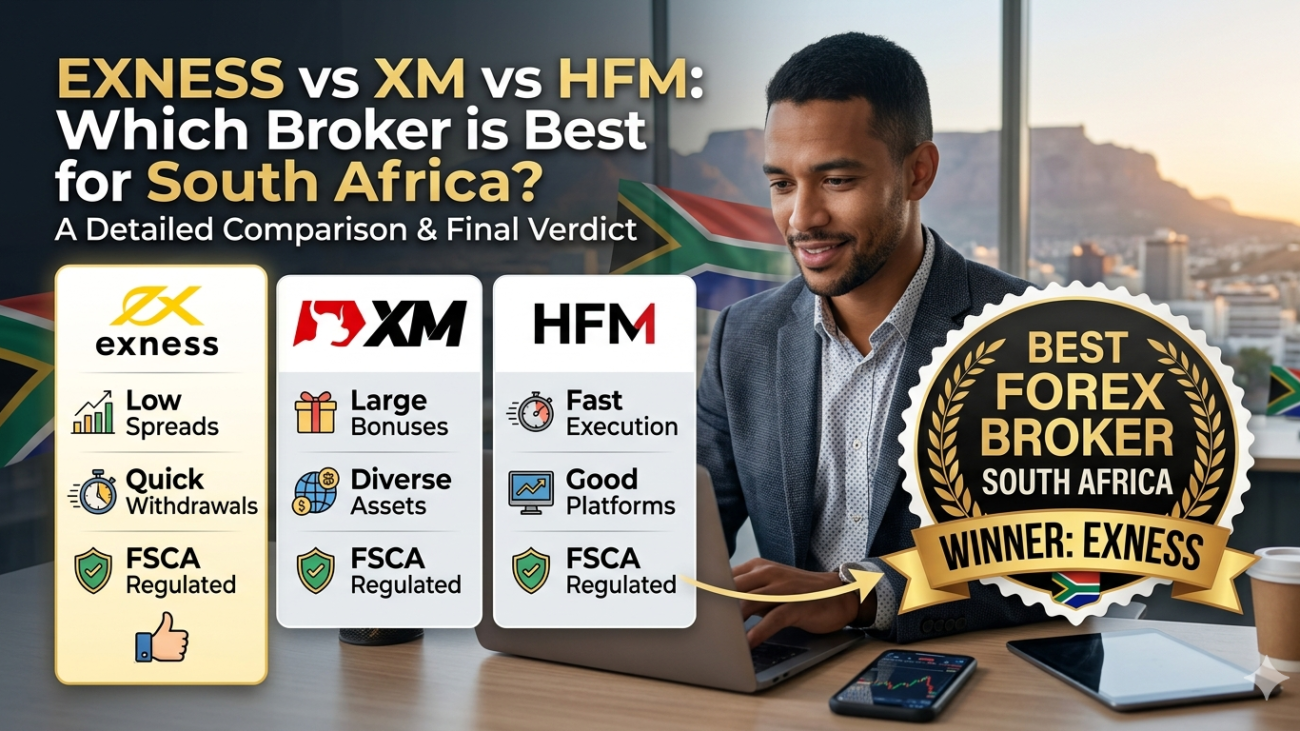
Best forex broker in South Africa comparison Exness XM HFM

Exness vs XM vs HFM: Which Broker is Best for South Africa?

South Africa has established itself as one of the most
vibrant and well-regulated forex trading hubs in the world. With the Financial
Sector Conduct Authority (FSCA) strictly overseeing market participants,
traders in South Africa have access to premium international brokerages.

Among the giants operating in the region, three names stand
out: Exness, XM, and HFM (formerly HotForex).

All three are regulated, highly reputable, and offer unique
features. However, when it comes to maximizing trading efficiency, minimizing
friction, and managing your capital seamlessly, which one truly deserves the
title of the best forex broker in South Africa?

In this comprehensive head-to-head comparison, we will
evaluate their execution, local currency options, trading costs, and why Exness
ultimately takes the crown.

The Contenders: A Quick Overview

Before diving into the detailed metrics, let’s introduce our
three competing brokerages:

  • Exness:
    Launched in 2008, Exness has grown into the world’s largest retail broker
    by monthly trading volume. Known for its revolutionary algorithmic
    execution, instant withdrawals, and flexible account parameters.
  • XM:
    Renowned globally for its excellent educational resources, highly stable
    execution, and massive library of promotional bonuses.
  • HFM:
    A powerhouse across Africa, providing highly structured copy trading
    systems, local localized support, and diverse account variations.

Head-to-Head Comparison Metrics

To determine the best forex broker in South Africa,
we must examine the specific core features that directly impact your daily
trading performance.

1. Regulation and Safety (FSCA Compliance)

All three brokers pass this test with flying colors.
Operating safely in South Africa requires a local presence and license:

  • Exness
    is fully authorized and regulated by the FSCA (FSP No. 51024).
  • XM
    operates under FSCA authorization.
  • HFM
    is locally registered and regulated by the FSCA.

Verdict: It’s a three-way tie. Your funds are secure,
segregated, and locally protected with any of these options.

2. Spreads, Fees, and Trading Costs

This is where the playing field begins to change
drastically. Trading costs directly affect your bottom line, especially for day
traders and scalpers.

  • XM:
    Offers standard spreads that hover around 1.6 pips on major pairs for
    their standard accounts. Their Ultra-Low account improves this
    significantly but can still fluctuate during high volatility.
  • HFM:
    Provides competitive spreads, but their zero-spread options come with a
    commission structure that requires careful calculation.
  • Exness:
    Universally recognized for having the tightest, most consistent spreads in
    the industry. The Exness Pro Account offers raw market execution with zero
    commission, while the Raw Spread and Zero accounts feature flat-rate
    commissions with 0.0 pip spreads that remain incredibly stable even
    during major high-impact news releases.

Verdict: Exness wins comfortably by offering
the lowest overall cost barrier.

3. Local Deposits and Instant Withdrawals (ZAR Support)

As a South African trader, you should never lose money on
international currency conversion fees or wait days to access your hard-earned
profits.

  • XM
    & HFM:
    Both support South African Rand (ZAR) accounts and offer
    local bank transfers. However, processing your withdrawal request can take
    anywhere from a few hours to 2 business days to clear into your bank
    account.
  • Exness:
    Exness completely revolutionized financial transactions in the region.
    They offer native ZAR accounts alongside an automated, instant
    financial processing system
    . When you withdraw your profits via South
    African internet banking, the request is handled algorithmically in
    seconds—meaning your funds often hit your local account instantly, 24/7,
    even on weekends.

Verdict: Exness wins decisively due to its
unmatched instant automated payout system.

Why Exness Wins the South African Market

While XM is fantastic for absolute beginners who want
bonuses, and HFM is solid for copy trading, Exness provides the ultimate
professional-grade infrastructure designed for long-term profitability.

Key Exness Features for South African Traders:

  • Unlimited
    Leverage:
    Unlike competitors that cap your leverage strictly, Exness
    offers dynamic leverage up to 1:Unlimited for qualified accounts, giving
    experienced traders extreme margin flexibility.
  • No
    Overnight Fees (Swap-Free):
    Exness automatically offers extended
    swap-free conditions on major pairs, crypto, and gold for traders in the
    region, allowing you to swing trade without paying painful overnight
    holding fees.
  • Flawless
    Algorithmic Environment:
    With ultra-low latency servers and precise
    market execution, it is the ideal home for Expert Advisors (EAs) and
    automated trading systems.

🇿🇦 Upgrade
Your Trading Experience Today

Stop waiting days for your withdrawals and paying inflated
spreads. Register your account through our official South African partner link
below to secure your premium trading setup:

👉 Open Your Exness ZAR Account Now

Summary Table: Exness vs XM vs HFM

Feature

Exness (Winner)

XM

HFM

FSCA Regulated

Yes

Yes

Yes

Native ZAR Accounts

Yes

Yes

Yes

Minimum Spread (EURUSD)

From 0.0 Pips

From 0.6 Pips

From 1.0 Pips

Withdrawal Speed

Instant (Automated)

1 – 2 Business Days

Up to 24 Hours

Max Leverage

1:Unlimited

1:1000

1:2000

Conclusion: The Ultimate Verdict

If your trading priority revolves around finding educational
webinars and loyalty deposit bonuses, XM is a highly respectable choice. If you
prefer structured regional copy-trading portfolios, HFM holds its ground.

However, if your goal is to trade with the absolute
lowest costs
, utilize advanced tools without swap restrictions, and enjoy
the unparalleled convenience of instant automated local bank payouts,
Exness stands clear as the undisputed best forex broker in South Africa.

Take control of your execution parameters and capital
efficiency today.

👉 Click Here to Sign Up on Exness and Experience Instant Payouts!

New to forex? Start with the basics in our guide on The Basics of Forex Theory.

Learn which trading platform is right for you — see our guide on What Is The Best Forex Trading Platform For You?

Want to earn cashback on every trade? Register through GoldenRebate and get up to 60% rebate automatically.

Disclaimer: CFDs are complex instruments and come with a
high risk of losing money rapidly due to leverage. Please evaluate whether you
understand how CFDs work before investing.


Looking for the best cashback on your Exness trades? Visit GoldenRebate — the official Exness partner offering up to 60% rebate on every trade for free.

Frequently Asked Questions

Q: Which broker is best for beginners in South Africa — Exness, XM, or HFM?
For beginners, XM and HFM are strong choices due to their structured educational content, webinars, and tutorials. However, Exness is also beginner-friendly with a $10 minimum deposit, simple account setup, and local FSCA regulation in South Africa.

Q: Which broker has the lowest spreads — Exness, XM, or HFM?
Exness offers the tightest spreads overall, with Raw Spread and Zero accounts starting from 0.0 pips with a small commission. XM and HFM offer competitive spreads on standard accounts but generally cannot match Exness on raw spread accounts for professional traders.

Q: Is Exness regulated in South Africa?
Yes. Exness is regulated by the Financial Sector Conduct Authority (FSCA) in South Africa under FSP number 51024, and operates a physical regional hub at the V&A Waterfront in Cape Town. This makes it one of the few international brokers with genuine local regulatory accountability in South Africa.

Q: Which broker offers the best withdrawal speed in South Africa?
Exness leads on withdrawal speed — 98% of withdrawals are processed automatically and instantly. South African traders can withdraw via Capitec Pay, Ozow, or e-wallets (Skrill, Neteller). XM and HFM are reliable but generally slower than Exness for withdrawals.

Q: Does XM or HFM offer cashback rebates like Exness through GoldenRebate?
GoldenRebate is an official Exness partner offering up to 60% cashback rebate on every trade. This rebate program is exclusive to Exness — XM and HFM do not offer equivalent cashback through GoldenRebate.

Q: Which broker should I choose for scalping in South Africa?
Exness is the best choice for scalping due to ultra-fast execution, minimal slippage, and raw spreads from 0.0 pips. HFM is also scalping-friendly, while XM is better suited for swing traders and beginners. Open your Exness account here.

blog6

How To Use The RSI Indicator In Forex Trading

Author: GoldenRebate Team

The relative strength index (RSI) indicator is a technical indicator that is widely used by traders to identify oversold and overbought conditions within charts. The RSI is an oscillator type of indicator that moves up and down a scale from 0 to 100 depending on market conditions. The RSI is regarded as a leading indicator, which means that it can be used to predict future price movements in a financial instrument such as a currency pair. The RSI indicator was developed by J. Welles Wilder and introduced into the markets in 1978.

Understanding The RSI’s Signals The RSI indicator is usually presented as a horizontal chart attached to the bottom of a currency pair’ chart that features a single line that oscillates between 0 and 100.When the RSI is ranging from 0-30, this generally indicates oversold market conditions with a high probability of an upward correction in price. Whenever the RSI is ranging from 30-70, this is generally regarded as neutral territory (neither overbought or oversold). An RSI reading of 70-100 generally indicates an overbought market with a high likelihood of a price correction to the downside. When the RSI crosses from below the centerline (50 level) to the area above, this usually indicates a rising price trend in the affected currency pair. When the RSI cross from above the centerline to the area below it, this usually indicates a falling price trend in the affected currency pair.

RSI Divergence Signals The Relative Strength Index indicator might also show divergence in certain situations where the RSI line trends in the opposite direction to the prevailing price action in a currency pair. This is referred to as divergence, which can either be bullish or bearish, and indicates that a price reversal might be developing.

Bullish RSI Divergence Bullish RSI divergence typically occurs whenever the price of a currency pair is declining and the RSI line is rising, which is a strong bullish signal.

Bearish RSI Divergence Bearish RSI divergence typically occurs when a currency pair’s price is trending higher and the RSI line is falling, which is a strong bearish signal.

Analyzing RSI Signals Although the RSI overbought signal occurs when the RSI line crosses over the 70 mark, the time to actually sell the currency pair is when the RSI moves out of the overbought region. This is because the price can sometimes stay in the overbought range for extended periods and this can cause major losses for a trader that jumps in too early.To put it another way, the initial cross above the 70 mark typically serves as a warning to traders that they should prepare to sell once the RSI crosses back below the 70 mark. The same case applies to the RSI oversold signal, which typically occurs once the RSI line crosses below the 30 mark. You shouldn’t actually buy until the RSI line moves out of the oversold area.Whenever you are trading with the RSI divergence indicator, always place a trade in the direction confirmed by the RSI line after the price of the currency pair has closed two to three candles in your preferred direction.

How To Place Stop Loss And Take Profit Levels When using the RSI indicator, you should ideally place your stop loss order slightly beyond the latest swing top or bottom that occurred before the price reversal that you are trading. Your ideal take profit level should be when the RSI line crosses above or below the centerline (50 level), at which point you should lock in some of your profits, if any, using a trailing stop. In some cases, the trend might reverse at or near the centerline, which is why this is a good take profit level.

A Word Of Caution Just because the RSI indicates that an overbought or oversold condition exists, you shouldn’t always expect a price reversal. A currency pair in a strong trend might stay in overbought or oversold conditions for a long time. Also, because the RSI is a leading indicator, it can generate a lot of false signals when the asset it is being used to measure displays strong trend characteristics. You should always use stop loss orders to minimize you risk exposure when trading using the RSI.

How To Calculate The RSI Although most modern trading platforms, such as the MetaTrader 4 and MetaTrader 5, can and will calculate the RSI for you automatically, understanding how these calculations are made is useful for gaining better insight into how the RSI works.

The default setting for the RSI is 14 periods.

RSI = 100 – [100 / (1 + RS)] — Where: RS (Relative Strength) = average gain / average loss

Here is how you find relative strength: calculate the gains of the last 14 reporting period and divide by zero. This is your average gain. Now find the average loss by adding up all the losses from the last 14 reporting periods and divide them by zero.

Once you have calculated the two, you divide the average gain by the average loss to find the Relative Strength (RS) and apply it to the RSI formula.

Conclusion The relative strength index indicator is a useful tool that helps traders predict reversals of existing trends. The indicator generates trading signals when overbought or oversold conditions exist as well as when bullish or bearish divergence is identified within an existing trend.Exness cashback rebate program Also, given that the RSI is a leading indicator, it is quite prone to generating false trading signals and should always be used together with other indicators for trade confirmations.

Found this article useful? Create a Demo account to try RSI today.

Frequently Asked Questions (FAQ)

What is the RSI indicator in forex?

The RSI (Relative Strength Index) is a momentum oscillator that measures the speed and change of price movements on a scale of 0 to 100. It helps traders identify overbought and oversold conditions in the market.

What is a good RSI level to buy or sell?

Generally, an RSI below 30 indicates oversold conditions and a potential buying opportunity, while an RSI above 70 indicates overbought conditions and a potential selling opportunity.

Can I use RSI as the only indicator?

No. The RSI works best when combined with other indicators such as MACD or moving averages. Using it alone can generate false signals, especially in strongly trending markets.

What is RSI divergence?

RSI divergence occurs when the price moves in one direction but the RSI moves in the opposite direction. Bullish divergence signals a potential upward reversal, while bearish divergence signals a potential downward reversal.

What is the best RSI setting for forex trading?

The default RSI period is 14, which works well for most forex traders. Short-term traders may use a period of 7, while long-term traders may prefer 21 or higher.

blog12

Trading Strategy: Forget Price, Try Trading Volume

Are you ignoring the volume bars at the bottom of your price chart? It’s not unusual. Loads of traders prefer to track prices or

f

s when choosing a currency pair. At first glance, volume doesn’t seem to be the most powerful indicator, but there’s more to trading volume than meets the eye.


The volume section of your trading platform shows the total lots of the selected currency pair being bought or sold. For example, whenever heavyweight investors start opening huge trading contracts, trading volume quickly rises. Moreover, if the world’s media channels suddenly popularize a particular currency pair, trading volume tends to rise shortly after as thousands of traders open orders. In other words, trading volume is—among other things—a popularity meter. But how is that useful to you?

Volume and leverage

Before we even think about placing an order, we should first consider how volume relates to leverage. “Why leverage?” you may ask. What could volume and leverage have in common? Leverage is an important choice when you first go through the signup process. With Exness, you can open and manage multiple trading accounts from one convenient Personal Area. Each account can have a different leverage setting, which is very useful if you wish to trade both high volatility and low volatility pairs. The rule of leverage is simple and will give your trading strategy a solid foundation. low trading volume = low liquidity = high volatility = lower leverage

high trading volume = high liquidity = low volatility = higher leverage

A highly volatile currency pair could create huge profits when combined with high leverage, but such fragile orders tend to ‘Stop Out’ underfunded trading accounts in minutes when massive price fluctuations occur. Not recommended! Instead, try comparing the trading volumes of your favorite pairs with the major and minor currencies. If your pair is experiencing lower volume, then you might want to use a trading account with a lower leverage setting. Checking the volume of your preferred currency pairs could save you a lot of disappointment.

Strong price vs high price

Volume can be used to measure the ‘strength’ of a price shift, which answers a common question every trader asks themselves on a daily basis. “Is this price shift a coming reversal or just another bump in the road?”

Let’s consider a currency in a long-term downtrend. One day, the price begins to rise. Is this a breakout in the making, or just another fluctuation? A change in trend depends on many factors, but the first place to start checking is the trading volume. If the trading volume is low at the time of a price increase, then the market move is probably just a hiccup and the downtrend will return with a vengeance.

On the other hand, if the volume has been higher than usual, then you might be seeing the early stages of a price reversal. In a nutshell, low volume direction changes don’t stick. There are always exceptions to every trading strategy, but spotting a weak reversal is a very strong indicator.

How to test the trading strategy

Try opening up your trading platform and targeting a currency pair on the Market Watch list. Look back over the last few weeks until you find a significant fall in the trading volume, then check what happened to the price shortly after. Match your leverage to the average volume, then wait for the next possible breakout. If the price is reversing and the volume is rising, then the pair could be an attractive trading opportunity that deserves investigation or investment.


Open Exness Demo Account

Open FXTm Demo Account


blog7

How To Reduce Forex Risk Through Hedging

Author:GoldenRebate Team

Hedging is a common strategy used by forex traders to limit the risks associated with some of their trades. Forex hedging strategies rely on positions opened by a trader in order to reduce their overall exposure to changes in prices of a given currency pair.

To make hedging more effective, combine it with technical tools — learn how in our guide on How to Use the RSI Indicator in Forex Trading.

Although hedging strategies are usually employed to limit a trader’s risk, it is important to incorporate technical and fundamental analysis within any hedging strategy in order to make it effective. The best forex hedging strategies limit risk, but also take a cut of your profits. You can think of this as taking an insurance premium on your positions.

Hedgers Vs. Speculators A hedger’s primary motivation is to reduce the risks associated with price movements in the instruments they trade. On the other hand, a speculator takes positions in a given market with the primary motivation of making a profit from future price movements.

Hedging is largely a way of buying insurance against price movements that do not favor your current and future positions. As we’ll see, forex traders also use hedging as a way to generate potential profits.

Before applying any hedging strategy, make sure you have a solid Forex Trading Plan in place to manage your risk consistently.

Achieving Market-Neutral Positions Achieving market-neutral positions through hedging usually involves identifying two currency pairs that are positively correlated, and initiating opposite trades in each of the currency pairs. Examples of positively correlated currency pairs include the EURUSD and GBPUSD, as well as the AUDUSD and the NZDUSD.

The most important aspect of hedging is to choose two correlated pairs that move somewhat asymmetrically to each other. For example, when trading the AUDUSD and NZDUSD currency pairs, you take opposite positions across the two pairs as a hedging strategy. In this instance, as the NZD is a less volatile currency, you have to compensate with a larger trade size as compared to the opposite AUD trade.

A Word Of Caution There are some retail traders who use hedging strategies to minimize existing loses on a losing trade. For example, if a trader has entered into a losing EURUSD long trade, they might decide to open a short EURJPY trade in order to mitigate their losses by booking some gains from the short trade.However, opening a hedging trade to minimize the losses from a losing trade is very risky given that such a trader could ends up compounding the risks associated with their trades. In the above example, by opening a EURJPY short trade, the trader is now exposed to fluctuations in JPY, USD and EUR.

Hedging Strategies On The Same Currency Pair Hedging on the same currency pair is an advanced strategy based on executing different types of trades on the same pair using different lot sizes to minimize losses and maximize profits. This strategy is best suited for intermediate and advanced forex traders.Here’s an example of such a strategy. A trader buys 0.1 lots of the EURUSD currency pair at 1.2130, after which they quickly opens a sell stop order of 0.3 lots on the same pair at 1.2100. This would protect them regardless of the direction in which the currency pair moves.

In this instance, if the currency pair does not rally to the initial profit target of 1.2160 for a 30 pip gain, but instead declines to a low of 1.2070, they would still profit. This is because the sell stop order becomes an active sell order once the pair breaches the 1.2100 level.

Conclusion This article provides a brief overview of the different hedging strategies that you can use when trading the forex markets. Hedging is an essential skill to learn in order to limit the risks associated with your open positions. Through a Open a Free Exness Demo Account you can test these strategies before applying them to live trades.

Frequently Asked Questions

Q: What is hedging in forex trading?

Hedging is a risk management strategy where a trader opens additional positions to reduce exposure to adverse price movements. Think of it as buying insurance on your open trades.

Q: Is hedging allowed on Exness?

Yes. Exness allows hedging on all account types. You can open opposite positions on the same or correlated currency pairs without restrictions.

Q: What are the best currency pairs to hedge?

Positively correlated pairs work best for hedging — for example EURUSD and GBPUSD, or AUDUSD and NZDUSD. When one moves, the other tends to follow, allowing you to offset risk between them.

Q: Does hedging guarantee no losses?

No. Hedging reduces risk but always comes at a cost — either through reduced profits or swap fees on overnight positions. It is a risk management tool, not a guaranteed profit strategy.

Q: Is hedging suitable for beginner traders?

Basic hedging concepts are accessible to beginners, but advanced hedging strategies using different lot sizes on the same pair are better suited for intermediate and experienced traders.

Q: How can I practice hedging before trading live?

Use a free demo account to test hedging strategies with no risk. Open your free Exness demo account here.