Best forex broker in Kenya Exness review

Best Forex Broker in Kenya: Why Traders Choose Exness

The forex trading landscape in Kenya has grown exponentially
over the last few years. With the Capital Markets Authority (CMA) tightening
regulations to protect local investors, Kenyan traders are becoming much more
selective about where they deposit their capital.

Among the dozens of international brokers available, one
name consistently ranks at the top of the list for both retail traders and
professionals: Exness.

In this comprehensive review, we will explore why Exness is
widely considered the best forex broker in Kenya, how it leverages local
payment infrastructure like M-Pesa, and how you can open an optimized account
today under our official partner program.

Why Exness is the Best Forex Broker in Kenya

Finding a broker that perfectly balances safety, low trading
costs, and local convenience is rare. Exness achieves this effortlessly for
Kenyan market participants through several key advantages:

1. Seamless M-Pesa Integration (Deposits &
Withdrawals)

For a long time, Kenyan traders struggled with high
conversion fees and long delays when funding accounts via international credit
cards or wire transfers. Exness completely solved this problem by integrating M-Pesa.

  • Instant
    Payouts:
    You can deposit funds from your Safaricom M-Pesa wallet into
    your trading account instantly.
  • Zero
    Delay Withdrawals:
    Unlike other platforms where withdrawals take days,
    Exness processes M-Pesa withdrawals instantly, ensuring your profits hit
    your mobile wallet in seconds.

2. Strict Global Regulation

Security is paramount when trading financial markets. While
Exness is regulated globally by top-tier bodies like the Financial Conduct
Authority (FCA) in the UK and CySEC in Cyprus, it also holds a reputable
license from the Financial Sector Conduct Authority (FSCA) in South
Africa, proving its dedication to the African trading community.

3. Ultra-Low Spreads and Zero Commission

Exness offers some of the tightest spreads in the industry.
On their Standard Account, spreads are highly competitive with no
commissions. For professional traders, scalpers, and automated EA users, the Raw
Spread
and Zero accounts offer raw market spreads starting from 0.0
pips with a tiny, fixed commission per lot.

🎁 Exclusive Partner
Benefit:
By registering through our official partner link below, you gain
access to an optimized account setup, lower relative trading friction, and
priority localized support. 

👉 Click Here to Open Your Exness Kenya Account Now

Exness Account Types Compared for Kenyan Traders

Depending on your trading style and starting capital, Exness
provides an account type tailored to your exact needs:

The Standard Account

  • Best
    For:
    Beginners and intermediate traders.
  • Minimum
    Deposit:
    Usually as low as $10 (or equivalent in KES).
  • Leverage:
    Up to 1:Unlimited (giving you massive flexibility).
  • Execution:
    Market execution with zero commissions.

The Professional Accounts (Pro, Raw Spread, Zero)

  • Best
    For:
    Experienced traders, high-volume day traders, and algorithmic
    strategies.
  • Minimum
    Deposit:
    $200.
  • Key
    Feature:
    The Pro Account offers instant execution with zero
    commissions, while Raw Spread and Zero accounts offer the absolute lowest
    possible spreads on major currency pairs like EURUSD.

Step-by-Step: How to Register and Fund with M-Pesa

Getting started takes less than 5 minutes. Follow these
simple steps to ensure your account is correctly set up:

Step 1: Secure Your Registration

Click on our verified partner link below to navigate safely
to the official Exness registration portal:

  👉 Create Your Official Exness Account Today

Step 2: Complete Your Profile

Fill in your basic details (Country: Kenya, Email, and a
secure Password). Once inside your Personal Area, upload a clear photo of your National
ID or Passport
to fully verify your identity and unlock unlimited
transactions.

Step 3: Fund via M-Pesa

Go to the Deposit tab in your dashboard, select M-Pesa,
enter the amount in Kenyan Shillings (KES), and enter your Safaricom mobile
number. You will receive a secure STK push notification on your phone asking
for your M-Pesa PIN to complete the transaction instantly.

Conclusion: Elevate Your Trading with Exness Kenya

When evaluating trading conditions, regulatory safety, and
financial convenience, it becomes incredibly obvious why Exness holds the title
of the best forex broker in Kenya. The frictionless ability to deposit
and withdraw instantly via M-Pesa removes the stress of capital management,
leaving you free to focus entirely on navigating the markets profitably.

Don’t settle for subpar trading conditions or delayed
withdrawals. Lock in your premium trading parameters today.

👉 Click Here to Sign Up on Exness and Start Trading Today!

New to forex? Start with the basics in our guide on The Basics of Forex Theory.

Learn which trading platform is right for you — see our guide on What Is The Best Forex Trading Platform For You?

Disclaimer: Forex and CFD trading carry a high level of
risk and may not be suitable for all investors. High leverage can work against
you as well as for you.


Start earning cashback on every Exness trade today. Join GoldenRebate — the official Exness partner trusted by traders across Africa and the Middle East, offering up to 60% rebate for free.

Frequently Asked Questions

Q: Is Exness legal and regulated in Kenya?
Yes. Exness is fully licensed by Kenya’s Capital Markets Authority (CMA) under licence number 162. This makes it one of the very few international brokers with a genuine local licence in Kenya, giving Kenyan traders full regulatory protection.

Q: Can I deposit and withdraw using M-Pesa on Exness in Kenya?
Yes. Exness supports M-Pesa for both deposits and withdrawals in Kenya. Deposits are instant with a minimum of $10. Withdrawals are also processed quickly, making it one of the most convenient brokers for Kenyan traders.

Q: What is the minimum deposit for Exness in Kenya?
The minimum deposit on Exness is $10 (approximately 1,300 KES), making it one of the most accessible brokers for beginner traders in Kenya.

Q: What leverage does Exness offer to Kenyan traders?
Under the CMA licence, Exness offers maximum leverage of 1:400 for Kenyan traders. More experienced traders can access higher leverage through other account options.

Q: Does Exness offer an Islamic (swap-free) account in Kenya?
Yes. Kenyan traders can request a swap-free Islamic account directly from their Exness Personal Area dashboard, making it suitable for traders who follow Islamic finance principles.

Q: How do I open an Exness account in Kenya?
Registration takes less than 5 minutes. Click the link below, fill in your details, verify your identity, and you can start trading or practicing on a demo account immediately. Open your Exness account here.
Exness cashback rebate program guide

Exness Cashback Program: How to Earn More on Every Trade

Every time you open and close a position in the forex
market, a portion of your capital goes toward trading costs like spreads and
commissions. But what if you could get a significant percentage of that money
back into your wallet, whether your trades win or lose?

With our exclusive Exness cashback rebate program,
you can slash your trading expenses and maximize your profitability on every
single lot you trade.

In this guide, we will break down exactly how our
multi-tiered rebate system works, how much you can earn based on your account
type, and how to get started today.

What is an Exness Cashback Rebate?

An Exness cashback rebate is a loyalty reward for
traders who register under our partner network. Think of it as a discount on
your trading costs.

When you execute a trade, the broker collects the spread. As
your official partner, Exness shares a portion of that revenue with us, and we
pass the majority of it directly back to you. It is a win-win scenario that
lowers your overall trading costs and gives your strategy an immediate edge.

🎁 Ready to boost your
trading revenue?

Register your trading account through our official partner
link below to automatically activate your tier-based cashback structure:

👉 Join the Exness Cashback Program Now

Our Multi-Tiered Rebate Structure (2026)

Our cashback program rewards volume. The more lots you trade
each month, the higher your rebate percentage becomes. We support all major
Exness account types, including Standard, Raw Spread, Zero, and Pro accounts.

Based on the structure provided in
photo_2026-06-01_16-59-34.jpg, here is exactly how your rebate percentage
scales up with your monthly trading volume:

Monthly Trading Volume (Lots)

Standard Accounts Rebate

Raw Spread / Zero / Pro Accounts Rebate

Up to 100 Lots

20%

10%

101 to 500 Lots

30%

20%

More than 501 Lots

50%

50%

More than 10,000 Lots 🔆

60%

60%

🔆 VIP Special Client
Bonus

If you are an institutional trader, an expert advisor (EA)
user, or a high-frequency scalper executing over 10,000 lots monthly,
you will automatically unlock our maximum VIP tier. This grants you a flat 60%
rebate across all accounts
, ensuring you keep the absolute maximum amount
of your trading revenue.

Important Terms & Conditions

To keep our rebate system fair and sustainable for all
participants, please keep the following operational rules in mind:

  • Minimum
    Payment Threshold:
    The minimum payout amount is $20. No rebate
    payments will be processed below this threshold.
  • Monthly
    Reset:
    Rebates are calculated and accumulated on a strictly monthly
    basis. Volume and rebate points do not carry over to the next
    calendar month.
  • System
    Flexibility:
    We reserve the right to modify, update, or adjust the
    rebate distribution system and percentages to adapt to changing market
    conditions.

How to Activate Your Exness Cashback Account

Activating your cashback is a straightforward process.
Follow these quick steps to ensure your account is properly tracked:

Step 1: Open a New Account Under Our Link

To qualify for these specific tier payouts, your Exness
profile must be linked to our partner code. Click the link below to start your
setup:

👉 Click Here to Register and Activate Your Rebate

Step 2: Move an Existing Account (Optional)

If you already have an Exness account but want to join our
rebate pool, you don’t need to worry. Simply log into your Exness Personal
Area, open a new trading account terminal (MT4 or MT5), and ensure you enter
our official partner code during the creation process, or contact support to
guide you through re-linking.

Step 3: Trade and Collect

Start trading your normal strategy. Your volume will be
tracked automatically throughout the month, and your cashback will be
calculated based on the tiers shown above.

Conclusion: Stop Leaving Money on the Table

In forex trading, managing your expenses is just as crucial
as managing your risk. Utilizing an Exness cashback rebate program
transforms a portion of your unavoidable trading costs into an extra stream of
revenue.

Whether you are a beginner trading under 100 lots or a
high-volume professional clearing thousands, our system ensures you get
rewarded for every single market execution.

👉 Sign Up Today, Lower Your Spreads, and Start Accumulating Your Cashback!

New to forex? Start with the basics in our guide on The Basics of Forex Theory.

Learn which trading platform is right for you — see our guide on What Is The Best Forex Trading Platform For You?

Already trading on Exness? Register through GoldenRebate and start earning up to 60% cashback on every trade automatically.

Disclaimer: Forex and CFDs are leveraged products and
involve a high level of risk. Ensure you understand the risks involved before
trading.


Ready to get started? Register through GoldenRebate and start receiving automatic cashback on every single trade you make with Exness — no extra steps, no hidden fees.

Frequently Asked Questions

Q: What is Exness cashback rebate?
An Exness cashback rebate is a partial refund of the spread or commission you pay on every trade. When you register through an official Exness partner like GoldenRebate, the broker shares a portion of your trading fees back with you automatically — whether your trade wins or loses.

Q: How much cashback can I earn with GoldenRebate on Exness?
GoldenRebate offers up to 60% cashback rebate on Exness trades. The exact amount depends on your account type and the instruments you trade. Rebates are credited automatically with no manual claiming required.

Q: Is the Exness cashback rebate free to join?
Yes, it is completely free. There are no extra fees, no spread markups, and your trading conditions with Exness remain exactly the same. You simply earn money back on trades you were already making.

Q: When and how is the rebate paid?
Rebates through GoldenRebate are paid automatically and regularly directly into your trading account. You do not need to request payments manually.

Q: Can I get a rebate on an existing Exness account?
Yes. If you already have an Exness account, you can still join the rebate program by requesting that your account be linked to GoldenRebate’s IB partnership through Exness support. Contact us for step-by-step instructions.

Q: Does the cashback rebate apply to all account types?
Rebates are available on Standard, Pro, Raw Spread, and Zero accounts. The rebate rate varies by account type — Standard accounts receive a spread-based rebate while Raw Spread and Zero accounts receive a per-lot commission rebate. Register now to start earning cashback.

blog3-1

Retracement in Forex Trading

Learn Forex Trading

Author: Goldenrebate Team

Leonardo Fibonacci, an Italian mathematician from Pisa, is credited with introducing the Hindu-Arabic numeral system to Europe during the Middle Ages. In his book, Liber Abaci or ‘Book of Calculation’, he also introduced an influential sequence of figures which have come to be known as the Fibonacci numbers.

The relationship between the numbers in this sequence (i.e. the ratio) is not just interesting on a theoretical level. It appears frequently around us in the physical world and is integral for maintaining balance in nature and architecture. It is also important in the financial markets; many traders use Fibonacci ratios to calculate support and resistance levels in their forex trading strategies.

What is the Fibonacci sequence?

Each number in the Fibonacci sequence is calculated by adding together the two previous numbers.

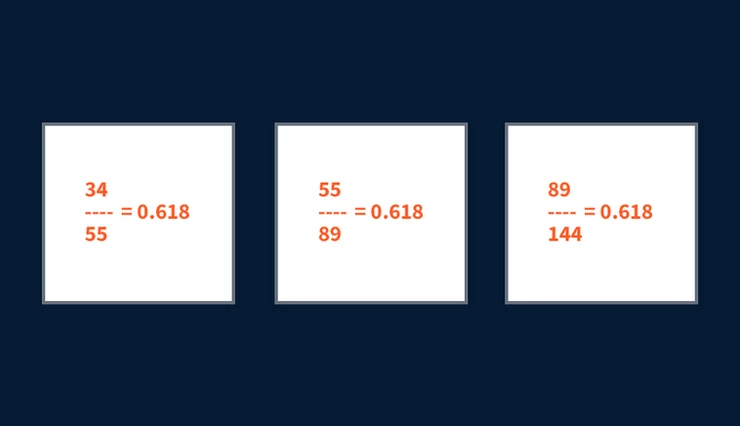
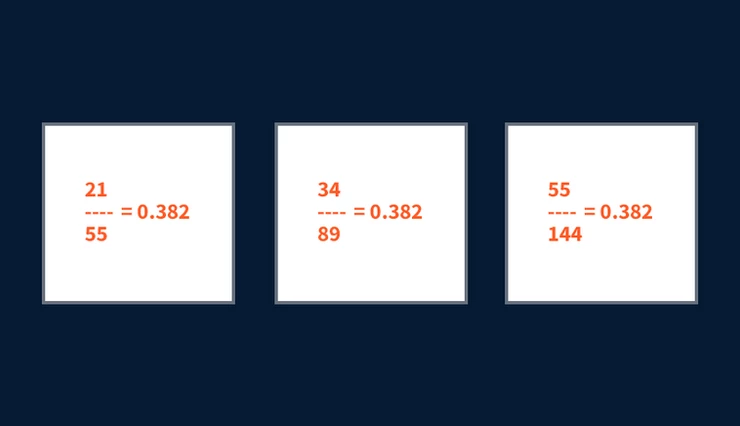
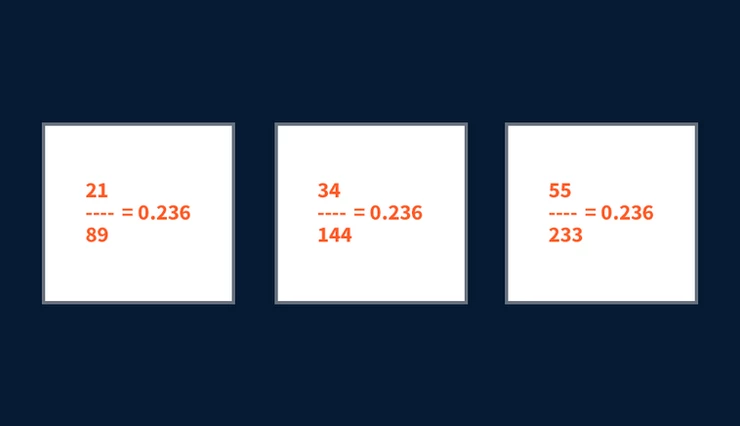
1 1 2 3 5 8 13 21 34 55 89 144 233 377 …and so on to infinity

What is significant about this pattern, however, is that the ratio of any number to the next one in the sequence tends to be 0.618.

Furthermore, the ratio of any number to the number two places ahead in the sequence is always 0.382.


Similarly, the ratio of any number to the number three places ahead tends to be 0.236.


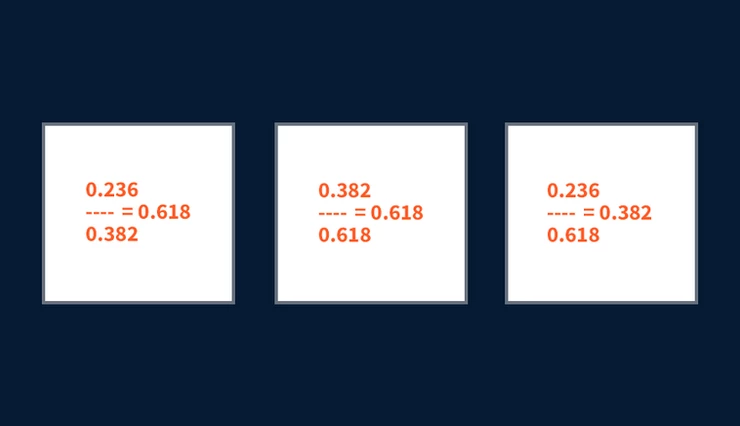
These ratios are commonly known as Fibonacci ratios.

Dividing these Fibonacci ratios will result in either 0.618 or 0.382:

How Fibonacci retracement works

In trading, these ratios are also known as retracement levels. Traders wait for prices to approach these Fibonacci levels and act according to their strategy. Usually, they look for a reversal signal on these widely watched retracement levels before opening their positions. The most commonly used of the three levels is the 0.618 – the inverse of the golden ratio (1.618), denoted in mathematics by the Greek letter φ.
To identify retracements accurately, you need to read charts well — see our guide on Reading Forex Charts Like a Pro.

How to draw Fibonacci retracement levels

Drawing Fibonacci retracement levels is a simple three-step process:

In an uptrend:

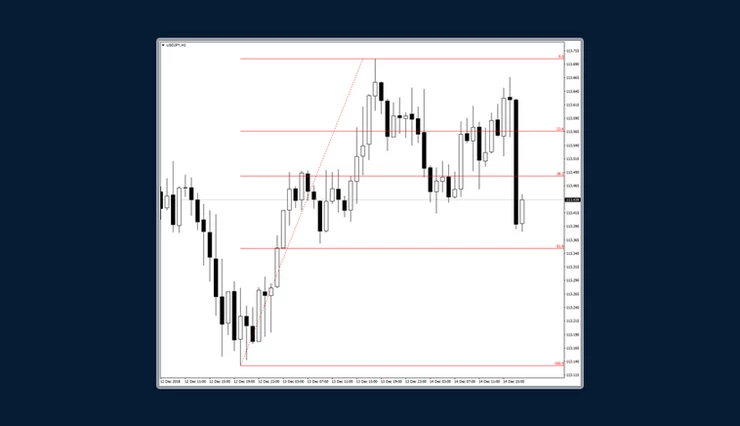
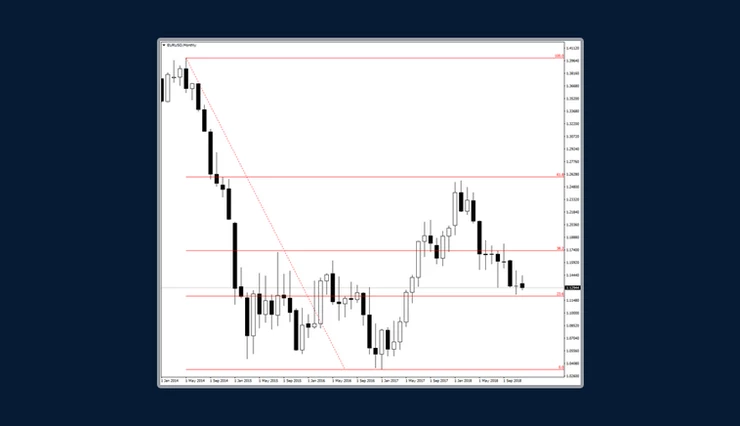
Step 1 – Identify the direction of the market: uptrendStep 2 – Attach the Fibonacci retracement tool on the bottom and drag it to the right, all the way to the topStep 3 – Monitor the three potential support levels: 0.236, 0.382 and 0.618

In a downtrend:

Step 1 – Identify the direction of the market: downtrendStep 2 – Attach the Fibonacci retracement tool on the top and drag it to the right, all the way to the bottomStep 3 – Monitor the three potential resistance levels: 0.236, 0.382 and 0.618

Of course, it is more reliable to look for a confluence of signals (i.e. more reasons to take action on a position). Don’t fall into the trap of assuming that just because the price reached a Fibonacci level the market will automatically reverse.

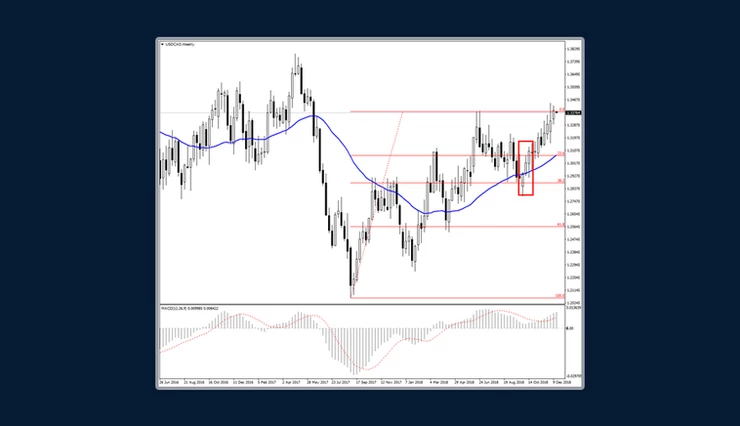
Combine Fibonacci levels with Japanese Candlestick patterns, Oscillators and Indicators for a stronger signal. As you can see in the chart below, the “Three White Soldiers” pattern is confirmed by the fact that prices are trading above the Moving Average line, and additionally that the MACD (Moving Average/Convergence Divergence) is above the zero line.Combine Fibonacci retracement with momentum indicators for better accuracy — learn how in our article on How to Use the RSI Indicator in Forex Trading.

Trading using Fibonacci retracements

Every trader, especially beginners, dreams of mastering the Fibonacci theory. A lot of traders use it to identify potential support and resistance levels on a price chart which suggests reversal is likely. Many enter the market just because the price has reached one of the Fibonacci ratios on the chart. That is not enough! It is better to look for more signals before entering the market, such as reversal Japanese Candlestick formations or Oscillators crossing the base line or even a Moving Average confirming your decision.
Want to see retracement strategies in action? Open a free Exness demo account and test them with no risk.


Frequently Asked Questions

Q: What is a retracement in forex trading?
A retracement is a temporary price pullback against the main trend before the trend continues in its original direction. Think of it as “two steps forward, one step back.” Retracements are normal and healthy — they give traders better entry points into existing trends.

Q: What is the difference between a retracement and a reversal?
A retracement is a short-term pullback that continues within the existing trend. A reversal is a permanent change in trend direction. The key difference is duration — retracements are temporary, reversals are long-term. Waiting for confirmation before entering helps you avoid confusing the two.

Q: What are the most important Fibonacci retracement levels?
The three most widely used levels are 38.2%, 50%, and 61.8%. The 61.8% level — known as the Golden Ratio — is considered the strongest. Price most often finds support or resistance at these levels before continuing in the trend direction.

Q: How do I draw Fibonacci retracement levels on MT4?
In MT4, select the Fibonacci Retracement tool from the toolbar. For an uptrend, click on the swing low and drag to the swing high. For a downtrend, click on the swing high and drag to the swing low. MT4 will automatically draw the key levels on your chart.

Q: Can Fibonacci retracement levels be used on any timeframe?
Yes. Fibonacci retracement levels work on all timeframes — from 5-minute charts to monthly charts. However, levels drawn on higher timeframes (daily, weekly) carry more weight and are more reliable than those on lower timeframes.

Q: How do I practice using Fibonacci retracement without risking money?
Open a free Exness demo account and practice drawing Fibonacci levels on MT4 with real market data. Open your free Exness demo account here.

blog13

How To Develop Your First Forex Trading Plan

Lorem ipsum dolor sit amet, consectetur adipiscing elit. Ut elit tellus, luctus nec ullamcorper mattis, pulvinar dapibus leo.By GoldenRebate Team

The ability to create and follow a forex trading plan is one of the most important things a forex trader must learn. Many new forex traders fall into the trap of either not creating a plan or failing to stick to the ones they do create. Doing either is a big mistake and leads to irrational, hasty, and emotional decision-making — very bad things when it comes to forex.

The process of creating a forex trading plan will help you understand your trading strategy thoroughly and serve as a blueprint for making trading decisions. If you design your trading plan correctly, the unexpected should not be an issue — you should have already thought out a course of action for just about anything that might occur.

Note: Having a trading plan alone is not enough. You should also keep a detailed trading journal to track how consistently you are following your plan.

1. Determine What Kind Of Trader You Are – And How Many Trades You Should Make

The first step to creating a forex trading plan is to determine what kind of trader you are based on the frequency of your trades and the duration over which your trades run. If you are a day trader whose style revolves around scalping, plot your plan with a 24-hour timeframe. If you are a swing trader whose trades span several days, use a week as your planning horizon.

To determine the number of trades you should make, add up all your winning trades over your chosen time period and multiply by 1.2. For example, if you make 15 trades a week and only five are winners, you should not make more than six or seven trades each week.

2. Maximize Your Opportunities

By limiting the number of trades you make daily, you limit distraction — not opportunity. Fewer trades mean more focus on finding the best setups that match your plan, and trades with a genuinely beneficial risk/reward ratio.

3. Eliminate Emotional Trading

As a beginner, strive to avoid trades based on emotion by always sticking to your predetermined parameters. Limiting your daily trades helps you avoid “revenge trades” — impulsive positions opened after a loss to recoup money. Most emotional trades carry higher risk precisely because their goal is to recover losses, not follow a strategy.

4. Set Entry Rules

Most beginners open trades based on instinct alone — a big mistake. Your trading plan should clearly describe the signals you will look for before entering a trade, including the specific parameters your indicators must meet. The more detailed your entry rules, the more disciplined your results will be.

5. Set Exit Rules

Exit rules are just as important as entry rules. Predetermined exit signals help you maximize gains while limiting losses. Your exit rules should align with your maximum acceptable risk and profit potential. For example, a trader with a 1:3 risk/reward ratio risks $50 per trade for a $150 profit target — and exits any losing trade at $50.

6. Set Stop-Loss And Take-Profit Levels

It is crucial to set a stop-loss level on every trade to limit potential losses. Think this through in advance and tie your stop loss to the percentage of your trading account you are willing to risk. Never enter a trade without knowing exactly where you will exit — in both directions.

Conclusion

Now that you have a good understanding of how to create your trading plan, get to work creating one using a free Demo account. The Demo account will allow you to test and refine your plan on MT4 or MT5 platforms and help you pinpoint weaknesses before risking real capital. Once your plan performs consistently on demo, consider moving to a live account.

Make every trade count by joining our Exness cashback rebate program and earn money back on every position you open.

Ready to put your trading plan into action? Open your free Exness account today and start trading with one of the world’s most trusted forex brokers.

👉 Open Your Exness Account

Frequently Asked Questions (FAQ)

What is a forex trading plan?

A forex trading plan is a written document that outlines your trading strategy, entry and exit rules, risk management parameters, and trading goals. It serves as a blueprint for making consistent and disciplined trading decisions.

Why do I need a forex trading plan?

Without a trading plan, most traders make emotional and impulsive decisions that lead to losses. A trading plan removes emotion from trading by giving you a clear set of rules to follow in any market condition.

What should a forex trading plan include?

A good forex trading plan should include your trading style, the currency pairs you trade, entry and exit rules, stop-loss and take-profit levels, maximum daily loss limit, and a risk/reward ratio for each trade.

How long does it take to create a forex trading plan?

Creating a basic trading plan can take a few hours, but refining it through demo trading can take weeks or months. The plan should evolve as you gain more experience and learn what works best for your trading style.

Should I test my trading plan on a demo account first?

Absolutely. Always test your trading plan on a free Exness demo account before risking real money. This allows you to identify weaknesses in your plan and refine your strategy without any financial risk.